











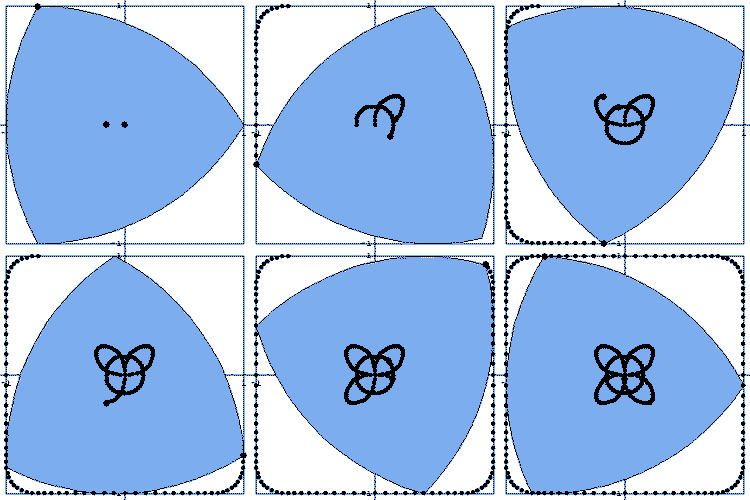


Interesting thread over on The Home Shop Machinist describing the use of H.J. Watts’ 1918 US patent 1,241,176 drill, based on the Reuleaux triangle (Wikipedia), for drilling a (mostly) square hole.
14 thoughts on “Drilling square holes with a Watts drill”
Comments are closed.

ADVERTISEMENT
Support Make:
Join Make: Community Today
Join Make: Community Today




wow, that looks alot like the motion of a rotor in a wankel engine
http://video.google.com/videosearch?q=wankel%20engine%20animation
That is a really cool technology. This reminds me of similar used to produce square or even many pointed star shaped holes inside a part on the show “How It’s Made” or perhaps “How Do They Do It?”
While this technology uses a floating plane for the project or an offset swiveling bit, the episode featured a technology where both the bit and the part to be carved were rotating at high speed. The bit had a tapered head and was drilled into the piece at a corresponding angle.
First thing that came to mind was a rotary engine, similar to http://www.me.berkeley.edu/mrcl/mini.html
Not sure how you could get the output to a standard gear train though.
I was thinking to myself before reading the article about how this would be done without a set of additional tools but the solution dating back almost a century is amazing!
Jon @ WoodMarvels.com
I dont see the point when compared to milling.
Milling is not a replacement because an endmill small enough to cut those corner radii is so lacking in rigidity that holes deeper than 5x the corner radius become unfeasable. Furthermore, the cutter life of that endmill will be extremely short due to vibration and chatter.
That said:
A similar result to Watts drilling, far cheaper, and requiring less tooling, is to pick the corner radius, layout the center of all 4 radii, and then drill a hole on size to depth at each laid out location. Grind another drillbit of the same size to do a flat-bottomed finish hole, and then drop that drillbit in to remove any of the tapers at theb ase of the hole. Then drill the center to depth to remove most of the leftover material (more efficient and cheaper than plunge milling, unless you use a helical plunge on a cnc mill), and finally go in with an endmill to clean up the sides.
Of course there is always sinker EDM, too.
For through holes you can grind a square broach out of HSS lathe cutter blanks.
The best solution is of course to design so as to avoid needing perfectly square holes with square corners.
Where can I buy a Watts Drill?