









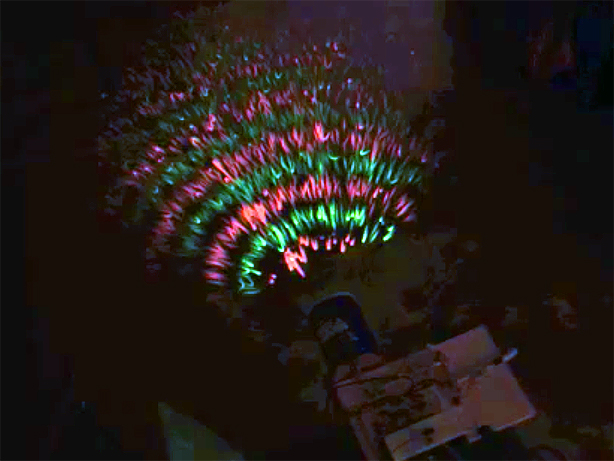
Radio whiz Greg Charvat just published this video showing off a very cool experiment with the low-cost coffee can radar system he and co-workers developed, in the fall of 2010, for MIT’s open courseware initiative.

In the video, Greg describes and demonstrates a simple circuit that causes a red/green LED on the receiving antenna to glow one color when the amplitude of the received wave is positive, and another when it is negative. Moving the LED back and forth in front of the transmitter, while taking a long-exposure photograph, gives a visual map of the wavefront in space. Impressive! [Thanks, Greg!]

More:

0 Responses to Seeing EM Waves With a Single LED

  1. This is just awesome!

    OK, who is going to be the first to make a radar detecting/visualizing LED cube?

    • I was thinking about that.  The problem with real-time methods, I think, is that it’s hard to build any kind of array in which the other elements of the array don’t interfere with the radar signal “downstream” from them.  Would love to hear from a more experienced hand with RF design, however…

      • Alexander Stewart on said:

        Here is a pretty good link about antenna array theory.
        http://www.ece.msstate.edu/~donohoe/ece4990notes6.pdf

        If you are not that good at the math, then what it really says is that antenna array patterns are a function (really a multiplication) of the individual elements antenna pattern and the antenna pattern of the physical layout of the antennas. The array’s pattern is done mostly through adjusting the phase and amplitude of the RF to each antenna element.

        Now there will be some parasitic interaction between the individual antenna elements, but that would only be one part of the overall antenna pattern. Playing with the array geometry may be able to overcome the distortion that would happen to the individual elements. Additionally, the antennas may be spaced far enough apart that the parasitic interaction could be negligible. 

  2. it appears to be detecting a standing wave pattern, or the led would be blinking at the frequency of the rf.

    • Alexander Stewart on said:

      That was my first thought too, but it is not a standing wave you are seeing. The apparent standing was is due to the coherency of the transmitted and received wave. Since this is part of a radar, there is probably one one oscillator in the system. Part of the transmitted signal is used to mix the receive signal to base band. There is some fixed amount of phase added from the output TX antenna, followed by a variable phase added due to the RX antenna’s position in space and finally the fixed phase between the RX antenna and the mixer. ignoring the fixed phases for now,  video signal looks like cos(f)*cos(f + offset), which when you filter and take the low pass signal will give something proportional to cos(offset), and hence why you don’t see the time varying portion of the EM wave.

Leave a Reply

Fill in your details below or click an icon to log in:

WordPress.com Logo

You are commenting using your WordPress.com account. Log Out / Change )

Twitter picture

You are commenting using your Twitter account. Log Out / Change )

Facebook photo

You are commenting using your Facebook account. Log Out / Change )

Connecting to %s

%d bloggers like this:
