












#6 is a small, easy to build, inexpensive, bare-bones computer. Like the Arduino, it was designed to easily teach art students about microcontrollers, interactivity, and electronics. It’s only $25 (cheaper than the Arduino) is open source, and uses open source software for programming. It uses a very popular chip (AVR) so there’s a good code library available for it. Check out more at the link below.
Microcontroller for the Folk – Link
28 thoughts on “#6 microcontroller packs a small punch”
Comments are closed.

ADVERTISEMENT
Support Make:
Join Make: Community Today
Join Make: Community Today


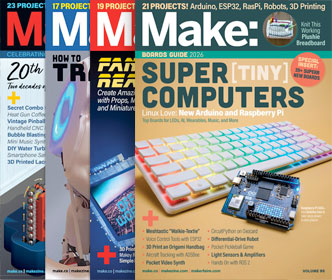

A Bare Bones Board (Arduino clone) kit is only $15, or $25 assembled, plus there’s a large-and-growing community to help you out.
I like how tiny it looks, though. Could be good for things like wearables.
I’d like to check them out, but they have a hideously slow web site :( Maybe it’s just the slash effect after being posted here…
Why this obsession with the Arduino?
An AVR and a DAPA ISP cable costs <$10 (and the ISP cable is reusable on the next AVR.) Program the darn thing in 'C'--it's really not that difficult to learn. LOADS of example code on the web...
There really isn’t anything special about the Arduino itself; it’s really not much more than a bootloader and a simple IDE. However, it’s standardized, open and well supported. That makes it nice for quick development and prototyping. People can get an assembled Arduino (or compatible clone) and start working immediately in code and not have to put together the support components for a bare AVR.
Yes, totally. There’s nothing special about the Arduino hardware. There are a multitude of cheaper ways of accomplishing the same thing.
But then Arduino has never been about just the hardware. It’s more a philosophy of bringing the fun of playing with microcontrollers to everyone. The #6 board is great, but on the homepage it mentions “malloc()”. Right off the bat that tells me it’s not going to be as friendly.
Another major aspect of Arduino is the community. Lots of people are playing with Arduino, and documenting their results, which then cause others to play with Arduino, and so on. So, many people who never would’ve touched microcontrollers now use them and are coming up with really interesting applications.
Finally, the term “Arduino” has become a stand-in for “standardizd, easy-to-use microcontroller” for me the way “Basic Stamp” was to me in the 90s. The word is a way of marking a project as approachable and knowable: if it can be implemented with an Arduino, you can use your familiarity of Arduino to more easily tease apart how the project works. So many projects I’ve seen used some oddball controller where half the effort of understanding the project was understanding the special features of the particular oddball microcontroller.
If you’re looking for inexpensive and easy then take a look at the TI EZ430 (MSP430). For $20 you get a programmer and project board. The target boards themselves (f2013 & f2012) are tiny and inexpensive at at $3.00 each. You can even use a debugger and step through your code, how cool is that.
TI.com/ez430
The Arduino IS what got me started using uCs. I saw it being used on a cool project and was like “Hey, I can do that!” So I went out and bought a bare bones board and … NEVER used it. Turns out that after following a very detailed tutorial over at Sparkfun, I ended up getting my feet wet by just using an stock Atmega8, gcc (WinAVR), and a parallel port programmer, and never looked back. But for those that are unfamiliar with programming in C, or who are intimidated by electronics, the Arduinio might not be a bad way to go.
Sorry Number 6, I don’t see things working out for ya. The massive community participation behind the Arduino and *Duino family will eclipse any board of this category, no matter how nice.
I tried to like Arduino…I really did. But the software killed it for me. The bootloader eats valuable program space. And the development software is excruciatingly slow for me (10 seconds to open some menus), and doesn’t have the nice features AVR Studio + WinAVR provide for simulation and debugging. As a standardized hardware platform, I’m all for it! But I’ll stick with AVRISP and the ability to use ANY microcontroller from Atmel. Most projects don’t need anything better than an ATTiny, which run with no support components required and cost under $2. My feeling is that the accumulated time spent waiting for the Arduino software to do things could be used to gain the slightly higher technical competence needed for AVR C or assembly.
Arduino has the advantage of being perceived as cool and being reasonably non-threatening for the novice (does this sound like a certain computer company?). It may be a bit clunkier for the die-hard programmer but if it gets people up to speed, I’m all for it — kind of like the Mac.
The 6 — nah. A basic board is $18 dollars from their source. Good for people with a bit of experience, but I can’t imagine many artists getting started at the “Oh, well, the first thing you do is fabricate your own PC board…” level.
LOL @ Arduino = Apple. Hooray for MadScott!
I’ll say this for the Arduino, you’re right that it makes getting up to speed in embedded systems quick and easy. I picked up an Arduino last week, and for my first project built an autopilot for our sailboat – awesome little tool. now I”m reading more, learning about other chips, getting back into writing code, etc, but Arduino was a quick spin-up.
very cool! I like how small it is…
Quite fascinating to have such open source hardware problems. Would definitely try this in coming days