












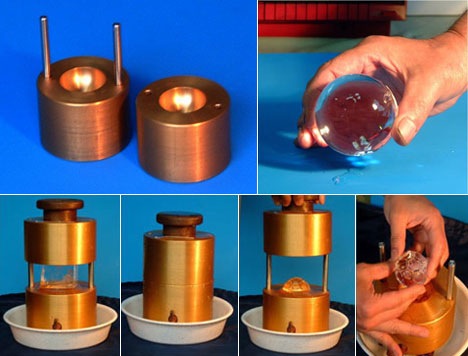
Hipstomp at the Core77 blog writes:
In some of Manhattan’s better Japanese-staffed bars, like Tribeca’s underground B-Flat, ice cubes are noticeably absent; ordering your scotch on the rocks gets you a large ice sphere. With less surface area than the same amount of ice rendered in cubes, a globe of ice will melt more slowly, keeping your drink cold without making it watery.
As an industrial designer, your correspondent couldn’t help but notice the parting line on B-Flat’s ice spheres; after all, it has to come out of a mold. But now a company called Taisin has come up with a clever device for making a perfect ice sphere with no parting line.
How does it work? You sandwich a large chunk of ice in between the two metal pieces pictured above. As the ice slowly melts, gravity brings the top half to close over the bottom half, enclosing what ice remains in its spherical cavity. Because the ice is in the process of melting into its new shape as the top closes, there’s no parting line. Clever!
28 thoughts on “Seamless ice spheres”
Comments are closed.

ADVERTISEMENT
Join Make: Community Today




Or you could just put the ice sphere in a beverage and the outside surface layer will melt, including the seam. Try it, it works every time.
-Bob
Have to say I agree with Bob here.
For the amount of effort involved in making one of your icespheres (let alone the milling involved in making the device), you could probably harness your latent mental energies and just float the water in the freezer.
The super-cool (heh) way to do this would be to make a very heavy oil, (say, one that has the same specific gravity as water) and freeze the water as it floats.
The metal for that ice shaper certainly looks brass colored, but brass should never be used in food grade applications. Brass will leech lead into the water and should be avoided.
http://www.cfsan.fda.gov/~dms/fdalead.html
The ice globes and cubes in Japanese bars are actually carved by men who make the ice for a living. The ice they use is frozen under pressuer as well, so it contains very little air and melts slowly. It’s so crystaline that when they hit a large bar of ice it actually rings.
The last time I checked my physics, the amount of surface area of the ice doesn’t matter in terms of how fast it will melt. As long as there is sufficinet surface area (If the drink remains “cold”, i.e. 32F, there is sufficient surface area) then the amount of ice that melts is a factor of how much heat is exiting the drink itself. The Sphere may be novel and a fun conversation piece, but it does not reduce the amount of liquid water released into the drink.
@ Jetson
Brass is an alloy of copper and zinc so there is no lead present at all. Looking through your fda link there is no mention of brass as a factor in cases of lead poisoning.
Last time I checked my physics, the cooling effect was actually caused by the melting of the ice…that is, melting is an endothermic reaction. If less surface area makes melting go more slowly, then cooling will be slower as well. The spheres are cool though.
@ tcarson
There are many different brass alloys, all of which contain copper/zinc (by definition), but they can also contain other metals; apparently lead is used widely (look up “free cutting brass”) to produce brasses which are readily machined. You certainly wouldn’t want that near your food.
Last time I checked my chemistry, melting was not an endothermic reaction. It’s a change of state. More to say but you can look it up to get it right if you want :)
So the device doesn’t actually freeze the spheres, it ‘melts’ an odd shape in to a spherical mold. what will they think of next? electronic kleenez dispensers??
Another way to make round ice balls is use a rubber squash ball. Cut a slit in the ball (and maybe make small holes at the ends of the slit to stop it spreading). Squeeze the ball to open it up, fill with water and then freeze. Once it is frozen you can easily pop out the ice ball.
I have done this and it works. Without the holes though the split tends to grow over time and you end up with a useless mold. I suspect you could make your own mold from some kind of silicone rubber perhaps?
Also I have no idea what is in squash balls and if there is any danger of anything leeching out into the ice so do it at your own risk!
Simon
Chris is right, melting is an endothermic process, all melting/freezing/boiling/condensing is endothermic (takes in heat) or exothermic (gives off heat). And I stand with him on this one, by the logic given, less surface area means less heat is transferred more slowly, not that it keeps your drink cooler longer, it just keeps your drink at a slightly higher temp than a cube would for a longer period of time. Energy is never gained or lost, it goes somewhere, so the same about of ice at the same temp has the same potential energy to take in heat, the only question is how long will it take to do so.
DJ
You can make ice spheres with silicone molds.
Have a look. http://chicagomoldschool.com/Merchant2/merchant.mvc?Screen=CTGY&Store_Code=CSOMMOS&Category_Code=SphM
We make these molds for sugar and chocolate use, but some restaurants buy them for ice spheres.
There’s a considerably cheaper version of this as well (same maker), and judging by the video it works REALLY fast. Here it is in all it’s seamless glory:
http://www.kilian-nakamura.com/catalog/ice-ball-mold-from-taisin-p-244.html
It’s enough to (almost) get me drinking whiskey