











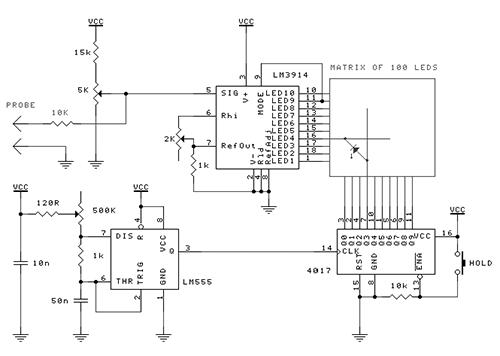

No substitute for a professional oscilloscope by far – but still could be a fun project to have a go at –
probably the best advantage is its very small size and the fact that it can run off the power supply of the circuit being tested. Although it has a low frequency range, it can still be used for most circuits. Its poor resolution will still allow for most waveforms to be visualized.”
[…]
It uses a matrix of 100 LED’s for a display, and does suffer from being slow and having rather poor resolution. Still we could display a sine wave running at 500Hz without trouble
Related:
Video: Dave Clausen and his LED oscilloscope project
12 thoughts on “LED O-scope schematic”
Comments are closed.

ADVERTISEMENT
Support Make:
Join Make: Community Today
Join Make: Community Today





There was an article about building an LED oscilliscope in popular electronics 10-15 years ago. I think it used a 20×20 array of LEDs.
I built a fancy version of this twenty years ago. It worked. Mine ganged two 4017s to achieve 16 columns (time resolution.) I also included a trigger circuit and selectable time periods. The major limitation was speed; I could only look at signals to about 12 KHz. Ironically, I had to use a real O-scope to get the thing going! I still have it packed away. A nice addition was a separate traingle wave sweep generator for demonstration.
Nowadays you have a great selection of packaged LED arrays which is nice!
interesting to see what became of this,
30 years ago I built a similar unit but a 10×16 metrix.
I used an lm555 timer for the scan speed into a 4 bit binary counter i Think a 74ls93 or 94, then put that into a 74ls154 1 of 16 out with binary in. and I had it up to 1 meg scan and that was its limitation although I was doing mostly audio work at the time, so it served me well.
Ritchie
A very similar circuit can be found in Forrest Mim’s Engineer’s Notebook, apparently adapted from a 1979 Popular Electronics article.
The author of the Popular Electronics article found it very amusing that his also needed a real oscilloscope to build his.
There’s something nice about seeing these old projects revisited.
MORE HERE: http://kitaudio.blogspot.com/2011/06/100-leds-solid-state-oscilloscope.html