











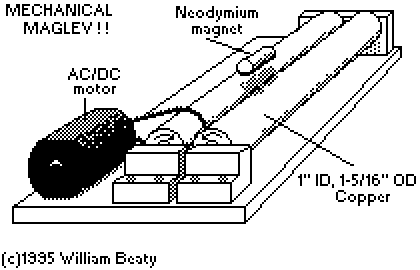
Bill Beaty documents his recipe for levitating neodymium magnets using two rotating coppers tubes. Note: The aptly named “Fantastically Dangerous Mechanical MagLev” could indeed seriously injure a person (you’ll notice Bill uses a clear plastic covering over the tubes to prevent the aforementioned nastiness) –
While working on science museum exhibits in 1990 I came up with the above idea: it is known that a spinning metal disk will lift and fling a strong magnet. Therefore, metal rods with opposite spin will lift a magnet but WON’T fling it sideways. It works! I used “sched-80″ heavy wall copper tubes about 1-3/8″ diameter, 12″ long, with 1/4″ wall thickness. I hammered aluminum plugs into the tubes, carved shaft-tips with a lathe, built endblocks and bearings, spun them with an AC/DC motor, and managed to levitate a stack of two 3/4” diameter neodymium magnets. The spinning tubes must move at about 5000 RPM before the magnet starts floating.
– All-mechanical magnetic levitation with neodymium supermagnets [via Hacked Gadgets]
16 thoughts on “DIY mechanical magnetic levitation”
Comments are closed.

ADVERTISEMENT
Join Make: Community Today




I think this would work with aluminum tubing. The advantages would be lighter weight and the availability of strong, precisely shaped (for balance) tubing. I’m thinking of the stuff aircraft builders use.
At the end of the video he suggests that the device might work upside-down. I’m here to say that my law, Lenz’s Law, says that this kind of induced magnetic field always opposes the original magnet’s field. So the magnet will be repelled whether it’s above or below the tubes. Also the tubes don’t have to be rotating in opposite directions and they can indeed be made of aluminum or anything else paramagnetic.
Heinrich Lenz has been dead for 143 years, but his law is alive and kicking.
> At the end of the video he suggests that the device might work upside-down.
The inductive drag should pull the magnet into the cleft, while the Lenz-law repulsion should push it away. Does the sum of the force graphs have a minimum? When upside-down, there does seem to be a weak “energy well” in the cleft, but it only applies to fairly small magnets, and it’s definitely too weak to lift a magnet against gravity. I tested with a 1/4″ rod-magnet on a balance arm. But I’m not *entirely* sure the energy well exists. If it exists, then if the whole device was in a zero-G environment, it could “grasp” a small magnet with stability in two dimensions. Carve a small slot in the tubes to add a 3rd stability axis. Buy me a ticket to the ISS for testing!
Heinrich Lenz is pretty sure the “inductive drag” and the “Lenz-law repulsion” you’re talking about are the same thing, pointed in the same direction. Also your balance wouldn’t lie to you.
That’s really cool! Back in my day I had to levitate magnets over superconductors :)
> Heinrich Lenz is pretty sure the “inductive drag” and the “Lenz-law repulsion” you’re talking about are the same thing, pointed in the same direction.
Nope. Where surfaces are concerned, “drag” and “Repulsion” forces are at 90deg by definition. Drag is parallel to the surface; repulsion is perpendicular.
But if they both vary in the same way versus distance to the magnet, then I think there can be no force minima or ‘energy well’ effects. Or does that only apply to 1/R^2 fields? Inductive levitation is not inverse square, otherwise it would be forbidden by Earnshaw.
> Also your balance wouldn’t lie to you
If you believe that instruments wouldn’t lie, then better avoid science or engineering careers! :) The rule of thumb it: distrust measurements until you’ve controlled or at least identified all the artifacts.
My balance was a plastic ruler with a small magnet taped on one end, balanced on my thumb. A quick and dirty test. The magnet seemed to first be pulled in, but then was repelled as usual at ~cm distance. But the “pull in” could easily have been caused by air motion. (I was using a tiny short magnet, so had to remove the acrylic cover to get access to the deep cleft region.)
I also suspect that the repulsion-vs-distance graph will change shape in proportion to RPM, since the skin depth varies with surface velocity. If an ‘energy well’ isn’t observed, better check to see whether one can arise during a certain range of surface velocities.
> That’s really cool! Back in my day I had to levitate magnets over superconductors :)
That’s where I got the idea! In 1989 I was trying to come up with a science-museum exhibit to simulate HTSC levitation without needing liquid nitrogen. I saw that at high surface velocity the skin depth approaches zero. So fast-spinning copper tubes/disks, if enclosed in close-fitting plastic shrouds, will seem superconductive (except for that pesky drag effect.) Parallel rods/tubes will give zero net drag if spun in opposite directions. My original brainstorm was to use concentric copper tubes rotating opposite, or stacked copper bowls rotating opposite.