











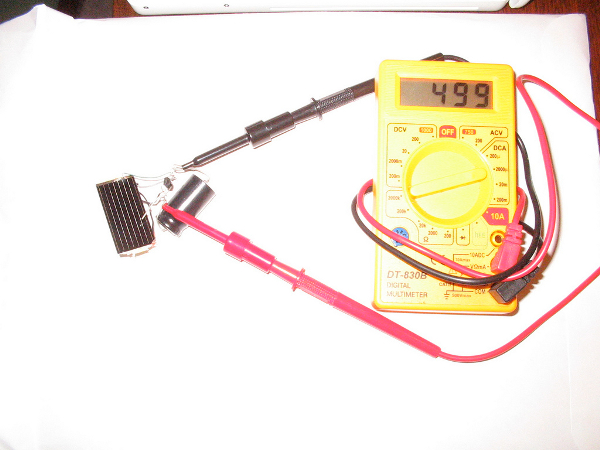

Photo from Petmar0 on Flickr
Pete responded in the comments to the the call for designs in the Rural Celly Charger article on Saturday.
How about connecting a joule-thief circuit (DC-DC upconverter) to a cap on one side and a small solar cell (like the ones in calculators) on the other? You pull off of the cap to the cell phone directly. If I remember correctly, most cell phones have internal Vregs between the battery and the rest of the circuitry, so that takes care of your OV protection. I’ll see if I can build this, and then get back to you.
Within a few hours on his busy Saturday, he had a rough build tested and posted up. His photos of the build have been added to the MAKE Flickr pool. Obviously, a few tests on some quickly assembled parts do not make a working solution, but they do demonstrate the concepts behind the circuit that could be worked up in a more detailed analysis and build. Ultimately, it would be ideal to come up with a design that can be replicated across cultures and great distances with minimal and less than ideal tools.

Photo from petmar0 on Flickr
The original article on Women of Uganda Network, or WOUGNET, told of how a Ugandan woman built her own charger after an unscrupulous vendor nicked her good battery and replaced it with a nearly dead one. The design that she came up with uses five D cell batteries to pump some charge into her phone. That should be quite a bit more voltage than is really needed to fill up a cell battery. She and her neighbors could benefit from a buildable design that could be made from easily sourced supplies.
The comments offered a number of perspectives on the problem and possible solutions. As is the case in many rural communities, she has access to a bicycle, some supplies, and maybe a bit of know-how about electricity. It is likely that her experiment was more ‘seat of the pants engineering’ than a studied formal solution based on book based research.
Generally, DC motors are relatively plentiful in electrojunk. Old cassette players, CD drives, VCRs, and more are good sources for surplus motors, and it is possible that a design based on a motor would be easy to build in rural Africa. The resistor and transistor needed for the Joule Thief could be harvested from many old devices. A capacitor could be used to store the charge, and then we would need a fitting to connect it to the phone. It is likely that many of the phones in a given community are of similar design and a spare could be appropriated for a cell phone charger.
How can you add to this idea? Could you design and build a cell charger only from junk? If you did not have access to a decent soldering iron, how would you get your connections consistent? If you have an idea to add to this conversation, bring it over to the comments. If you can, build up a sample circuit like Pete did and show it to us through a post on your blog, or you can add it to the MAKE Flickr pool.
12 thoughts on “Solar joule thief cell charger”
Comments are closed.

ADVERTISEMENT
Join Make: Community Today




How common is the “electrojunk” described in rural Africa? If there are old broken VCRs and cassette players there, perhaps an easier solution might be to (re)use one of the motors from those devices to serve as a simple generator. VCRs have all kinds of pulleys, etc. in them, too. If she was willing to ride her bike 20mi into town to charge her cellphone, she could just as easily have propped her bike up and ran it in a stationary mode with a motor shaft friction-fit to the wheel. My guess is that would generate plenty of juice to charge a cellphone, too…
Please check
http://www.beam-wiki.org/wiki/Solar_engine
and
http://en.wikipedia.org/wiki/Solar_Engine
Cool! The EZSE is exactly what we need, but after we:
1. upconvert to 5-6 VDC (to charge the battery)
and
2. put a cap. across the outputs to avoid pulse-charging the cell phone too quickly, which will wear out its battery.
Thanks!
Hello makers! I’ve made some tests to find alternatives to soldering irons. One approach could be done with a transformer with 12V output and carbon pieces. Is not really easy to make pretty connections, but it works. I’ve used an old 12V/1500mA transformer, some wires, a cork and two little pieces of carbon from a pencil, with a little space between it. The carbon heats when touches the solder and reaches the temperature needed to melt it.
Other way to make circuits without soldering irons is using two pieces of metal: a little piece of copper and another of iron, to keep temperature in copper last longer. If put together, they can be heated in a fire source and grabbed with pliers.
Strip of aluminum cut from a soda can could be rolled into a small cylinder and used to make a crimp connector. Crimped with pliers or even smashed with a hammer or rock. Careful not to smash the transistor.
My dad built car battery crimps from copper pipe. A good way to not have to soldier is to make a twisted wire junction. Put the circuit together and wrap copper wire around it. Solid copper from the insides of the devices can easily be harnessed.