












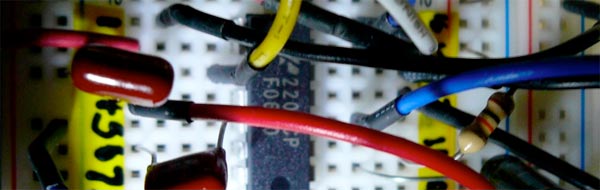
If you’ve been watching the Circuit Skills videos, you’ve likely heard me grumble a bit about using breadboards. Indeed, I have much respect for anyone who can keep using a breadboarded electronics project and have it remain functional indefinitely. I dunno – perhaps I’m just a bit too rough-and-tumble with my hardware, but how so many folks find the patience and grace to build complex projects using a bajillion unsoldered jumpers on a breadboard, I may never know –

photo by Sebastian Tomczak, one of his many daring breadboard builds
Seriously people – I love electronics, but for me, building something like the above image is akin to playing some kind of sadistic circuit Jenga. One false move and I’ll have to recheck every wire!
So instead of continuing to gripe about such a widely-loved experimentor’s platform, I decided to have a go at making my own. I figure the majority of my b-board woes stemmed from the fact that each metal clip/contact is tucked away beneath that iconic plastic bezel grid. That grid does a good job of insulating connections from wayward leads and such, but I’m willing to give up that safeguard in exchange for some more reliable connections.

I’m a big fan of these fancy ‘machine-pin’ headers, mainly because they can connect to several different lead sizes and do so with a surprisingly firm grip.
After finding a good deal on a bunch of those header strips, I also come across some unusual perfboard with IC/bus connections modeled after the familiar breadboard layout. One rather lengthy soldering session spent combining those items left me with my very own machine-pin breadboard alternative –


A “headerboard”, if you will … err, “socketboard” mayhaps. Whatever you call it, this thing makes some impressively sturdy non-permanent connections. One downside though – the headers won’t accept some wider leads (power diodes, etc) but the directly accessible (and visible) contacts just feels more reliable and manageable. And for me that worth adapting a couple of leads for.
So what’s next? Thinking I may have a go at the decidedly old-school real wooden breadboard + nails & wire –

photo by crochambeau of experimentalists anonymous
… umm, perhaps strictly as a bit of historical research. yeah.
9 thoughts on “When breadboards break thy brain … build a better breadboard”
Comments are closed.

ADVERTISEMENT
Join Make: Community Today





An even more extreme version of the breadboard shown in the last photo is the “bird’s nest” or “rat’s nest” method. This eliminates the breadboard and pins altogether, and the components are simply wired to each other in mid-air. There’s an example on the cover of Bob Pease’s “Troubleshooting Analog Circuits”.
PS. Did you see the photos of the Sinclair ZX Spectrum ULA, re-built on solderless breadboard at the Vintage Computer Festival at Bletchley Park?
Since I missed out on the HAM generation, I’ve always been intrigued by the Manhattan style construction technique.
Everyone talks about this PDF* as the definitive source, couldn’t find a Wikipedia page! :(
http://web.archive.org/web/20060904180006/http://www.k7qo.net/manhattan.pdf
*note, PDF was offline, this is a 2006 waybackmachine link.
But other techniques are easier.
I also made up an “Inverted Manhattan” which worked well.
…which is…
Using a plain copper clad as the base/ground, like Manhattan. Then I add a proto board that is a grid of the copper donuts, but add this with the donuts facing up. It is like having Manhattan with a grid of the connection points already in place.
Wire wrap. It’s secure. Wires don’t come loose. The rat’s nest is 1/10th the size, because the wire is thinner. Stick square header pins in breadboad, and you have instant wire-wrap points.
I find bread boarding is much easier using good quality hookup wires. I use the kind that are wires with metal pins soldered to the ends with rubber boots over the soldering. They sometimes break or the boots fall off but they are so cheap I just thrown duff ones away. They are like this: http://www.surplustronics.co.nz/shop/product-HW0015.html
Using header pins like that will kind of work. I have done it myself before. But, as you mention, the holes are a little small for all components. Really they are designed for DIP package IC legs I think. Also I don’t think they are rated for many insert/remove cycles. In the past I find they eventually lose their grip and don’t hold too well.
The best prototyping system I ever used was back in the mid 90s in the UK. It is a combination of a board like you made on the front and wire wrap type pins on the back. Well, more like split pins where you push the wire down between two metal prongs and it bites through the wire insulation. Phone sockets in NZ work the same way. You could simply plug the components on the front side like a breadboard then using a little tool connect them up on the back by pushing down the wires into the prongs on the back of the pins. Much more secure than bread boarding. Each pin could take multiple wires.
I thought it was called Speedwrap but my memory might be hazy as I now can’t find anything about them. Never seen them since. I remember looking them up a the time to buy myself one but they were horribly expensive. Perhaps that’s why I can’t find them now.
Bugger, found it now! It’s called Speedwire. http://en.wikipedia.org/wiki/Speedwire
Or was. Doesn’t seem to exist anymore.
Nice idea, good thinking :)
This is brilliant. Saw it a while back and lost it – didn’t know what to call these. Found it again thankfully :)