






ReviewsArchive: Reviews

June 30, 2009

Book Review: Wayne Goddard's $50 Knife Shop

goddard_cover.jpg

I've wanted to get into knifemaking since I was a teenager, but for years had been deterred by the belief that I first needed to buy a bunch of expensive equipment, like a 3-wheel belt grinder and an annealing oven. Then I found Wayne Goddard's $50 Knife Shop, which is a compilation of material originally prepared for Goddard's eponymous column in BLADE magazine. It kind of does for knifemaking what Dave Gingery's books did for foundrywork, going back to the historical fundamentals of the technology to get at what you really need to do good work. Goodies include homemade forges and anvils, homemade disc and belt grinders, scavenging steel for blades (including forging wire rope to make Damascus steel), finishing techniques, backyard heat treating, and a whole chapter on "tribal knifemaking," which is the modern art of making knives without using electricity. Fascinating stuff.

Posted by Sean Michael Ragan | Jun 30, 2009 08:00 AM
Education, Makers, Reviews | Permalink | Comments (3) | Email Entry | Suggest a Site

June 21, 2009

All hail Dave Gingery

gingery charcoal furnace.jpg

If you hang around makers long enough, especially older ones, sooner or later somebody will mention Dave Gingery. And then everybody within earshot will either A) genuflect or B) look around in confusion at all the people who are genuflecting. For those in the latter category, here's an explanation I wrote for Supernaturale awhile back:

Some people are better with tools than others. Like most human attributes, there's a normal distribution of this talent, with a few exceptionally handy-capped people, a few übermechaniker, and most of the rest of us somewhere in between. The late, great Dave Gingery definitely belongs in the "über" category. His classic 6-book series, available for decades now through Lindsay Technical Books, begins with instruction about how to build a home blast furnace and sand table so you can melt scrap metal and cast your own metal parts from wooden patterns. The remaining six books go on to describe how to use these castings to make your own lathe, metal shaper, milling machine, drill press, and indexing head. The order is important, because each tool requires the use of the previous machines in its construction. While the project seems a bit ambitious for me given my available time, I keep a set of the books around on the off-chance I'll be solely responsible for rebuilding industrial society in some sort of post-apocalyptic scenario.

Dave and Vince Gingery.jpg

Dave, sadly, left us in 2004. Personally, I think there should be a formal day of remembrance among makers. Meanwhile, Dave's son Vince is carrying the torch and has published a healthy oeuvre of DIY books himself. The works of both father and son are available through Lindsay Technical Books.

From the pages of MAKE:

Make04LindsayTechnicalBooksReviewp188.jpg

Dale Dougherty reviewed Lindsay's Technical Books way back in MAKE 04. The review includes some classic Gingery quotes.

More:

Posted by Sean Michael Ragan | Jun 21, 2009 04:00 PM
DIY Projects, Makers, Reviews | Permalink | Comments (3) | Email Entry | Suggest a Site

June 17, 2009

Book Review: Caveman Chemistry by Kevin Dunn

cavemanchemistrycover.jpg

My recent post on glassknapping mentioned Kevin Dunn's 2003 book Caveman Chemistry, and I've received many requests for a dedicated review. So here goes!

Caveman Chemistry came to my attention a few years ago through the Lindsay Technical Books catalog. I'm a chemist by profession and a hacker by calling, with a long-standing interest in garage science, so the book's title was basically irresistible to me. I plunked down my nickel and twiddled my thumbs for a week while the snails carried it to my doorstep.


Read full story

Posted by Sean Michael Ragan | Jun 17, 2009 11:00 AM
Chemistry, DIY Projects, Education, Reviews | Permalink | Comments (1) | Email Entry | Suggest a Site

June 12, 2009

The IT Crowd on DVD in the States

TheITCrowd_S2_large.jpg In early April of this year, a fairly significant event happened for my family. Geeky as it may sound, my husband, sons, and I were ecstatic to learn that the first season of The IT Crowd was available on DVD in a format that we could use here in the United States. My husband Bruce posted the news to GeekDad, and we all gathered round ye old plasma TV to enjoy the laughs. But it was over all too quickly. Were we doomed to Land of the Lost reruns on Hulu?

Thankfully, we're now looking forward to the end of this month, when The IT Crowd, The Complete Season 2 comes out on US format DVD on June 30th. Sure, you can watch it online or on the IFC channel, but we'll be happy to have the whole series on DVD, both for the funny 1337 extras and the subtitles, which my son uses (he wears hearing aids).

Word on the internets is that the 4th season of The IT Crowd will begin in July in the UK, and a Season 3 DVD may hit the States this fall. Bring on the IT Brits!

Posted by Shawn Connally | Jun 12, 2009 09:00 AM
Home Entertainment, Reviews | Permalink | Comments (9) | Email Entry | Suggest a Site

April 30, 2009

Glue anything to anything

this_to_that.jpg

Ever get confused about what sort of glue to use on a project? I'm twice degreed in Chemistry, and I certainly do. A great resource is This to That,, a comprehensive "glue advice" database run by a theatrical prop-builder and some buddies. They say:

We aren't a front for any manufacturer or some National Glue Association (if such a thing even exists.) Our recommendations are totally impartial. We have advertisers but they don't influence our selections at all. And they never will. We promise.

The folks at This to That were kind enough to give MAKE permission to reprint their main glue chart in The Maker's Notebook, so it's available in the notebook's reference section in the back.


In the Maker Shed:
Makershedsmall


notebookCover.jpg

Pick up The Maker's Notebook ($19.99) for all your big ideas, diagrams, patterns, etc. Exclusive to the Maker Shed: Sticker sheets and a band closure to customize your book.

Posted by Sean Michael Ragan | Apr 30, 2009 05:30 PM
Crafts, Makers, Paper Crafts, Reviews, Toolbox | Permalink | Comments (5) | Email Entry | Suggest a Site

February 8, 2009

Maker Shed weekly wrap-up

newkits1.jpg It was a busy week in the Maker Shed. We announced 2 new kits, the Deluxe learn to solder kit and the Arduino controlled servo robot. We had a lot of great builds and reviews too!


We started the week with my How-to Tuesday: Arduino 101 blink an LED, which seemed to be very popular with all the people getting into programming these amazing little micro-controllers.


Collin had a great how-to video about making games with Meggy Jr. I really like his unique sun-catching game that he programmed. I have to pick up a Meggy Jr. and try my hands at programming my own game.


Later in the week I made a post about building my new favorite kit by Gakken, the Stirling Engine Kit. It's an amazing kit, full of high quality parts. I really enjoyed learning about how these engines work. I have a few plans on hacking this kit, but more on that in a later post.

SERB_2b.jpg
Gareth finished up the week with 2 great posts from the Maker Shed. His first post was a review of the SERB Robot kit. He was really impressed by the quality and completeness of the kit. I plan on doing more posts about programming this cool kit in the near future.

eccentricCubicleCover.jpg
Gareth also posted a great excerpt from the book Eccentric Cubicle. I don't own this book, but after reading this excerpt it's a must-have for my book collection. What a great read about finding hidden gems in the scrap yard.

Posted by Marc de Vinck | Feb 8, 2009 01:00 AM
Arduino, DIY Projects, Electronics, Kits, MAKE Video, Maker Shed Store, Reviews, Robotics, Science, Something I want to learn to do... | Permalink | Comments (0) | Email Entry | Suggest a Site

January 23, 2009

Chronulieta cigar box clock

chronulieta.jpg

Jared Boone, of ShareBrained Technology, was kind enough to send me a brand-new Chronulator 2.0 kit. It's an Arduino-compliant analog clock (or anything you want) that uses panel meters as the display. I've written up a full review for MAKE volume 17 (verdict: great kit).

This is a photo I took of the clock I built. I used a cigar box for a case, mounted the board on top, and printed some stock clock faces for the meters (I'm dying to redesign those to match the lovely Romeo Y Julieta typography when I get some time). My more pressing modification is to add some LEDs for face illumination.

Chronulator 2.0 kit

Posted by John Park | Jan 23, 2009 05:00 PM
Arduino, Electronics, Kits, Reviews | Permalink | Comments (0) | Email Entry | Suggest a Site

December 5, 2008

The Manga Guide to Statistics

mg_statistics_big.jpg

We recently got a copy of No Starch Press's The Manga Guide to Statistics, by Shin Takahashi - but I didn't get to look at it for a few days because my son snagged it pretty much as it came through the door. Which confirms my theory - if you want to introduce a subject that kids wouldn't normally be very interested in, give it an amusing storyline and wrap it in cartoons.

In The Manga Guide to Statistics, our heroine Rui is determined to learn about statistics to impress the dreamy Mr. Igarashi and begs her father for a tutor. Soon she's spending her Saturdays with geeky, bespectacled Mr. Yamamoto, who patiently teaches her all about the fundamentals of statistics: topics like data categorization, averages, graphing, and standard deviation.

Reluctant statistics students of all ages will enjoy learning along with Rui in this charming, easy-to-read guide, which uses real-world examples like teen magazine quizzes, bowling games, test scores, and ramen noodle prices. Examples, exercises, and answer keys help you follow along and check your work. An appendix showing how to perform statistics calculations in Microsoft Excel makes it easy to put Rui's lessons into practice.

manga_sample.jpg


Once I (finally!) had a chance to look at the book, I really liked it. I have to admit I wasn't wild about statistics in college; this book was a lot more fun than my statistics textbook. Each chapter starts with a cartoon that's followed by supplemental text, then exercises and a summary, so you have the material presented in several different ways, that helps you remember. The pace of the book is good; the chapters present the concepts in bite-sized pieces and the storyline was funny. I'm sure my son didn't completely learn everything that was presented, but someday, when he's faced with Cramer's coefficient and chi-square distributions (I know I can't protect him from these things forever), he'll have some familiarity with the ideas and they will be easier to learn and use.

No Starch is publishing The Manga Guide to Statistics as the first of a series of educational manga previously published in Japan. We're really looking forward to seeing the rest, especially the one about electricity that's due out in April.

Posted by Patti Schiendelman | Dec 5, 2008 07:00 AM
Kids, Reviews | Permalink | Comments (4) | Email Entry | Suggest a Site

December 4, 2008

Handmade duct tape roses, and similar projects @ NYTimes

9780596519520-2
F7F36H0F42X3Itn.Medium
The Instructables book has a nice little write up in the NYTimes! Penelope Green writes-

The duct tape roses I made over Thanksgiving were fetching (until they were gummed by the cat), but post-turkey lethargy prevented me from digging into the meatiest projects in “The Best of Instructables” (Make: Books; $34.99). One example: the concrete light bulb wall hook, described as “an excellent excuse for driving a lag bolt into your wall” by its inventor, Ray Alderman. He and it are emblematic of the instructables universe, a blogging community of do-it-yourself-ers, robot-makers, food hackers and techno-geeks who share their crafty ways at Make magazine and Instructables (makezine.com and instructables.com), sometimes selling the finished products on etsy.com, the online bazaar for handmade things.

Posted by Phillip Torrone | Dec 4, 2008 09:00 AM
Instructables, Reviews | Permalink | Comments (0) | Email Entry | Suggest a Site

December 1, 2008

Mr Wizard's 400 Experiments in Science

Mr-Wizards-400-Experiments-In-Science-Cover-459X600
Chris reviewed "The Golden Book of Chemistry Experiments" as well as "Mr Wizard's 400 Experiments in Science", he writes -

"Mr Wizards 400 Experiments in Science". (Reno: "Emilio Lizardo is a top scientist, dummkopf." Perfect Tommy: "So was Mr. Wizard." -The Adventures of Buckaroo Banzai, now available on DVD!). Written by Mr Wizard himself, Don Herbert with Hy Ruchlis, this book is more about demonstrating scientific principles and phenomena in the home with less-sophisticated equipment. No beakers and Bunsen burners, this is all water glasses, pencils, string, tin cans and rubber bands. Just like the original Mr Wizard shows. This stuff is great. This book, thankfully, is a little more affordable! There seem to be several reprints of this with different covers, as you can see from the Amazon link. There's even one called "Soft Blu Bonnet Margarine Presents Mr. Wizard's 400 Easy Experiments in Science by Don Ruchlis, Hy Herbert". Because when I think of melting something on my toast, I want to think of chemistry! And who the heck are these Hy Herbert and Don Ruchlis guys?

Posted by Phillip Torrone | Dec 1, 2008 05:00 AM
Retro, Reviews, Science | Permalink | Comments (0) | Email Entry | Suggest a Site

November 19, 2008

A Revolution in DIY engineering - How to Build With Grid Beam

How-To-Build-With-Grid-Beam
A review of How to Build With Grid Beam @ The Citizen Scientist. Sheldon writes-

How to Build With Grid Beam is a guide to a clever and flexible system of construction for a wide range of home-built projects, from storage units to work spaces to furniture, vehicles, and structures. The system relies on the use of “sticks” or beams of square tube steel or aluminum or wood with holes placed at regular intervals along the length of each stick. Using lag bolts or other fasteners, these sticks can be assembled quickly and easily into structures that are quite robust and easily adapted and reconfigured. And when you are finished with a project, you simply disassemble the project and use the components for something else. By using adapters and add-ons, most of which can be found in hardware stores, industrial supply houses, or fabricated in even a modestly-equipped shop, the system can be expanded to encompass a staggering array of applications.

Posted by Phillip Torrone | Nov 19, 2008 12:00 AM
Reviews | Permalink | Comments (7) | Email Entry | Suggest a Site

November 8, 2008

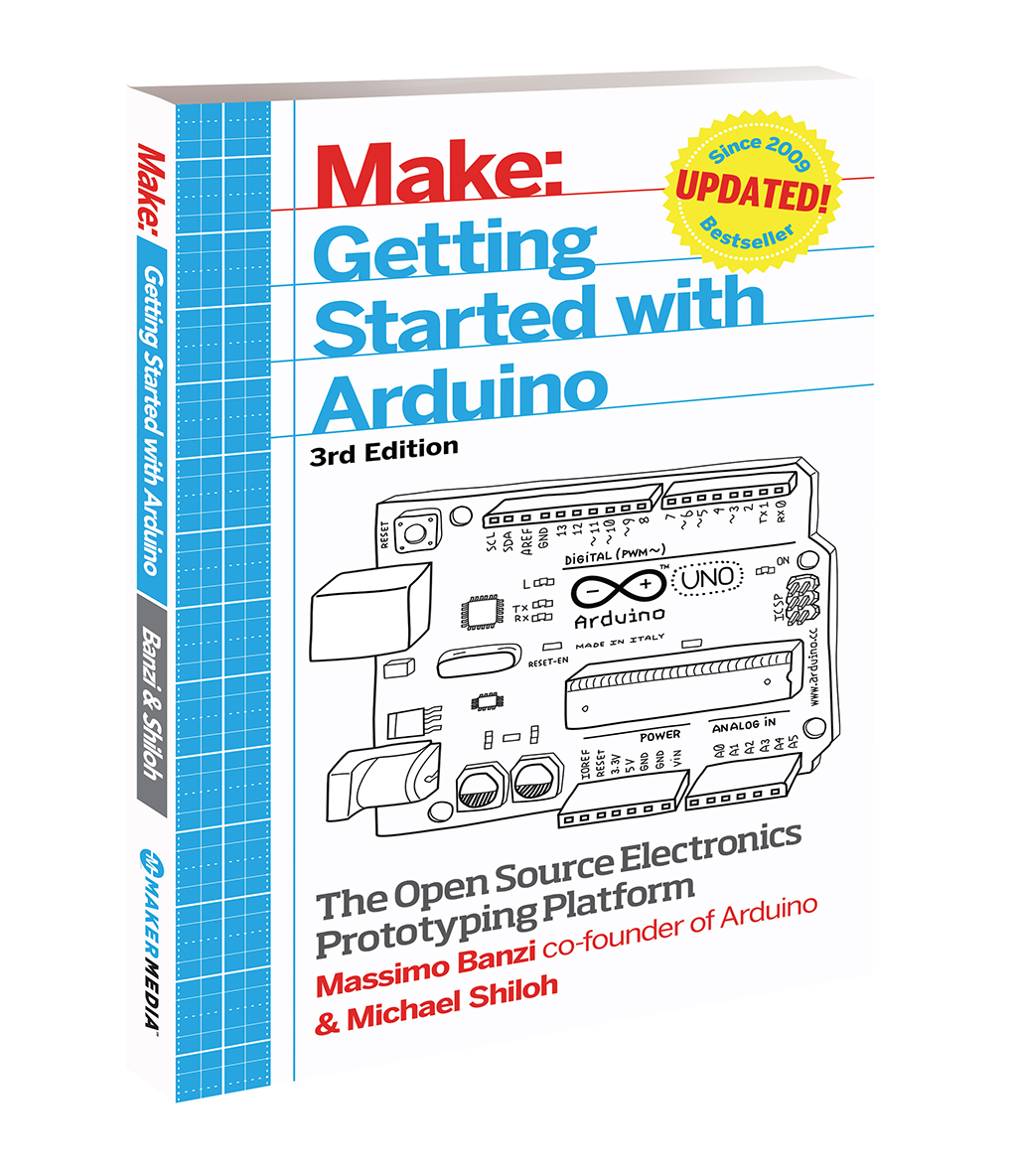
Another New book at Maker Faire: Getting Started with Arduino

978059615551113-2.jpg Yesterday I wrote about a great new book that I picked up at Maker Faire. Actually, I picked up 2 new books at Maker Faire, the other one was Getting Started with Arduino by Massimo Banzi, co-founder of Arduino. Massimo did a great job explaining all about this amazing little micro-controller and basic electronics. Here are some of the topics covered in the book:

Getting Started with Arduino is a great place to start your journey into the amazing, and sometimes crazy, world of micro-controllers and physical computing.

In the Maker Shed:
Makershedsmall
Arduino Family
Make: Arduino

Posted by Marc de Vinck | Nov 8, 2008 08:00 AM
Arduino, Electronics, Maker Shed Store, Reviews | Permalink | Comments (0) | Email Entry | Suggest a Site

November 7, 2008

New book at Maker Faire: The Best of instructables Volume I

9780596519520-12.jpg While I was at Maker Faire, I picked up a new book from the Maker Shed called The Best of Instructables Volume I. It's a really cool 300+ page book that's filled with over 120 great projects. One of my favorite quotes from the book was written by Eric Wilhelm of instructables "Making things by hand is cool again. You can be a creator, not just a consumer." Awesome!
Instructables.com has become one of the most popular magnets for makers and DIY enthusiasts of all stripes. Now, with more than 10,000 projects to choose from, the Instructables staff, editors of MAKE: Magazine, and the Instructables community itself have put together a collection of technology how-to's from the site. The Best of Instructables Volume 1 includes plenty of clear, full-color photographs, complete step-by-step instructions, and tips, tricks, and new build techniques you won't find anywhere else. Over 300 pages!

There are a couple of PDF sample chapters online.
md-boib.png
I really like the Magnetic Refrigerator Lights [PDF] and the DIY Vacuum Former [PDF].
md-boib2.png
Another really popular project is the screen-printing tutorial. [PDF]

You can pick up a copy in the Maker Shed, it's a really great read!

Posted by Marc de Vinck | Nov 7, 2008 03:00 AM
Maker Shed Store, Reviews | Permalink | Comments (0) | Email Entry | Suggest a Site

October 13, 2008

The "$50 and Up Underground House Book"

Uhb Lrg.Jpg
$50 and Up Underground House Book – Underground Housing and Shelter via Cool Tools (review).

The $50 & Up Underground House Book teaches how to build the lowest cost, most sunshine-filled, best ventilated and driest underground houses of all. It teaches how to incorporate greenhouses, root cellars and fallout shelters into an underground home. It covers both hillside and flat land design, and explains how to solve drainage problems with dependable gravity rather then expensive, failure-prone building materials. It also details ways to pass or otherwise deal with the building codes.

Posted by Phillip Torrone | Oct 13, 2008 08:00 AM
Reviews, Toolbox | Permalink | Comments (2) | Email Entry | Suggest a Site

August 6, 2008

Review - The VCO Chip Cookbook

Vco Cookbook

If you're interested in building an analog synthesizer then the VCO (voltage controlled oscillator) circuit is the best place to start. Oscillators form the core of the instrument, generating basic waveforms which are then shaped and shifted by accompanying components like LFOs, VCAs, and filters and then delivered to our ears as tasty electronic audio candy.

I recently picked up a copy of synth-designer Thomas Henry's VCO Chip cookbook from SMS Electronics. The 100+ page book covers three chips - the 566, 8038, and XR-2206 function generator. The cookbook covers several recipes for attaining sine, triangle, and square waves from each chip with difficulties ranging from beginner-friendly to advanced-worthy. As a bonus, instructions for some unusual wave-shapers (rampoid, anyone?) and basic test devices are drawn out as well. Most of the plans included are intended for use with a +/-15V power supply. It's also worth mentioning that the 566 and 8038 IC's are no longer manufactured but can be purchased via ebay, and several rare/surplus electronics dealers.

I sat down and assembled one of the XR circuits on a breadboard in about an hour. Once I had things powered up and oscillating, I removed the pitch control potentiometer and replaced it with a couple force-sensing resistors which I'd been waiting to put to good use. You can see the scratchtastic results below -

It's refreshing to have a nice spiral bound manual at the workbench instead of referring to the multitude of webpages and printouts I'd begrudgingly grown used to. I found Henry's explanations and schematics easy to follow and I plan on using that XR-2206 circuit for a few upcoming projects.

- The New VCO Chip Cookbook

- SMS Audio Electronics

Posted by Collin Cunningham | Aug 6, 2008 01:00 PM
Electronics, Music, Reviews | Permalink | Comments (0) | Email Entry | Suggest a Site

July 31, 2008

Femisapien robot review..


Robotsrule has a giant review of the new Femisapien robot, for $99 it's look worth it for the parts, sensors and learning interface alone...

For me the posing interface is the most powerful and fun method of playing with Femisapien. As you can see in the accompanying video review, you can create a Femisapien dance or skit in literally seconds. You put her in Learning Mode and you simply move her at one of two different speeds, slow or fast. That's it. After each movement she will beep at you to tell you she's memorized the movement. Then just adding keep movements until you're done, up to 80 movements total. To finish the sequence just wait 4 seconds or tilt her head out of Learning mode. Any time you want to see the sequence just wave your hand in front of her face. It really is that simple. This brings us to her second interface mode, the Hand Gesture interface.


Posted by Phillip Torrone | Jul 31, 2008 09:00 AM
Reviews, Robotics | Permalink | Comments (0) | Email Entry | Suggest a Site

June 10, 2008

The Chemical History of a Candle

Book Review  Fig 1 May 2008 Faradaycoverimage
The latest Citzien Scientist has a great review of TThe Chemical History of a Candle Michael Faraday. Mike writes...

Michael Faraday, a man with little formal education, is regarded as one of the greatest scientists of all time. He is also considered the father of electrical engineering. During the Christmas holidays of 1860 and 1861, Faraday presented a series of six lectures before a Juvenile Auditory at the Royal Institution of Great Britain. In addition to these six lectures, this book includes an additional lecture on the element platinum.

Faraday was an amazing individual who overcame many setbacks with determination and perseverance. When he was an apprenticed book binder, Faraday attended a series of lectures given by Sir Humphrey Davy and took detailed notes. He later transcribed the lectures into a note book and presented it to Sir Humphrey, who offered Faraday a job.

In addition to my admiration of the great Michael Faraday, SAS’s own Forrest M. Mims III remarked that he considered Michael Faraday “a great inspiration and personal hero.” Albert Einstein stated that he considered Isaac Newton, Michael Faraday, and James Clerk Maxwell as three of the most influential people in the history of science. This book was recommended to me by 2002 Nobel Laureate in Chemistry, Dr. John B. Fenn, who is also a long standing member of the Michael Faraday fan club.


Posted by Phillip Torrone | Jun 10, 2008 08:00 AM
Reviews, Science | Permalink | Comments (2) | Email Entry | Suggest a Site

April 28, 2008

MAKE Interview: DIY video mixers and more with Karl Klomp

rsv01.jpg "OSD-glitcher", (Klomp, 2006, 2007)

Interview/Article by Jonah Brucker-Cohen

In the multifarious world of circuit bending outdated audio and video sampling devices, there is a strong community of artists and makers who are pushing the envelope on their designs with each new incarnation of their work. One of these impresarios is Dutch artist and maker, Karl Klomp. Klomp's work includes modded video samplers and intricately bent video descramblers and sync generators that change their visual output based on audio feeds and are completely customizable through many switches, knobs, and other sensor inputs. Make recently caught up with Klomp to discuss his approach to building these devices and to discover exactly how many custom knobs are necessary to generate the optimal bent performance.

More images and full Interview at the link below.


Read full story

Posted by Jonah Brucker-Cohen | Apr 28, 2008 07:00 AM
Arts, Computers, Electronics, Music, Remake, Reviews, The Maker File | Permalink | Comments (0) | Email Entry | Suggest a Site

April 8, 2008

The Craftsman by Richard Sennett


sennett.jpg

Core77 has a review up of Richard Sennett's book "The Craftsman," which

is a conglomerate of case studies that explore the relationship of hand to mind, craftsmanship to Enlightenment. Herein, Sennett, a renown London-based sociologist with a zest for the human experience, argues that the most basic, fundamental ability we humans share is that of craft. When properly trained, this process functions as muscle memory, literally training the mind while working the hand. If its up to Sennett, all those hours spent learning how to throw clay pots, plane wood, and mix plaster for some toy-design/coffee-maker/mobile-phone project actually might just make you, the designer-cum-craftsman, a more enlightened person. From the computer screen to the workshop table, it's the stuff we've known for years: think, make, share, and do it again. It's what we wake up to do every morning, and what we dream about at night.

I know what's on my summer reading list...

Posted by Becky Stern | Apr 8, 2008 07:00 PM
Reviews | Permalink | Comments (0) | Email Entry | Suggest a Site

March 31, 2008

Five hundred and seven mechanical movements

51Nd6Sja5Vl. Ss500
Dugg writes in -

One reader of The Automata / Automaton Blog wrote to me with an interesting question. "I'm looking for a simple mechanism to convert rotational motion to reciprocal motion along the SAME axis as the rotation, not perpendicular."

I decided to investigate potential solutions in one of my favorite books on mechanisms, Five Hundred and Seven Mechanical Movements: Embracing All Those Which Are Most Important in Dynamics, Hydraulics, Hydrostatics, Pneumatics, Steam Engines... (Astragal Press, 1995).


Answers and more here. Looks like a great book!


Posted by Phillip Torrone | Mar 31, 2008 07:00 AM
Retro, Reviews, Science | Permalink | Comments (4) | Email Entry | Suggest a Site

Void your warranty, violate a user agreement, fry a circuit, blow a fuse, poke an eye out. Make: The risk-takers, the doers, the makers of things... Welcome to Make: Online!


CRAFT Maker Shed Maker Faire MAKE television
MAKE: en Español MAKE: Japan


Check out all of the episodes of Make: television


Connect with MAKE

Be a MAKE fan on Facebook MAKE on Facebook
Visit our Facebook page and become a fan of MAKE!
MAKE on Twitter MAKE on Twitter
Follow our MAKE tweets!
MAKE Flickr Pool MAKE on Flickr
Join our MAKE Flickr Pool!
    make_tips on Twitter

    MAKE's RSS feed is here.
    Add MAKE to iGoogle - GoogleGoogle.
    How to add MAKE to your RSS reader - Real simple.
    Add MAKE on FriendFeed


    Advertise here with FM.

    Why advertise on MAKE?
    Read what folks are saying about us!

    Click here to advertise on MAKE!

    MAKE wins Treehugger Best of Green Award

    MAKE wins Brit Insurance Design Award

    Subscribe to MAKE Magazine!

    Make: Online authors!

    Gareth Branwyn, Chris Connors (guest author), Collin Cunningham, Marc de Vinck, Peter Horvath (intern), Kip Kay, Goli Mohammadi, John Park, Sean Ragan, Becky Stern, Phillip Torrone

    Suggest a Site!

    Current Podcast

    itunesdl.gif How-To Tuesday: Arduino 101 & the PING))) ultrasonic sensor The PING))) ultrasonic sensor is a really easy way to measure distance with a micro-controller. All you have to do is hook up 3 wires and upload some code. These sensors are great for robots, alarm systems, or any... More...

    Get the Make: Online sent via email
    Enter your email to receive Make: Online each day:


    Subscribe to MAKE Magazine!

    Recent Posts from the Craft: Blog