Make: Projects
Digital TV Coat-Hanger Antenna
Build your own digital TV antenna from wire hangers, a piece of wood and some pipe.
Television antennas are comprised of a series of metal rods cut to exact lengths and positioned so they receive a particular television frequency. The following design was invented in the 1960s by an engineer named Doyt Hoverman. It is particularly sensitive in the UHF frequency range, the same range used for the majority of digital television transmissions.
This isn’t a project of my making, I merely wanted to comment on it in this space. All credit goes to Make:television for posting the (attached) instruction PDF.
Watch John Park do this.
Steps
Step #1: Mark the antenna frame
Next


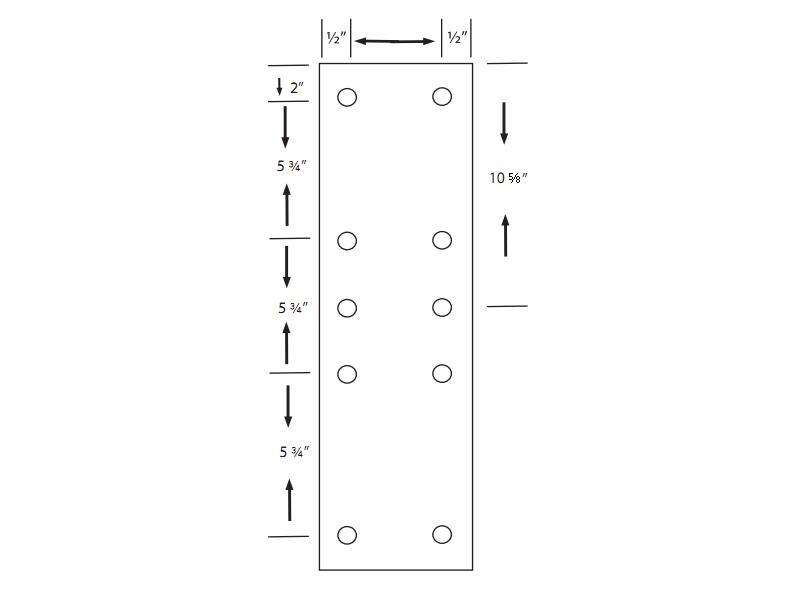
- Begin construction of the antenna by marking a 3” x 20” board as shown. Note that these dimensions are important to get a good signal with the finished antenna.
- This diagram was modified from the version in the PDF.
Conclusion
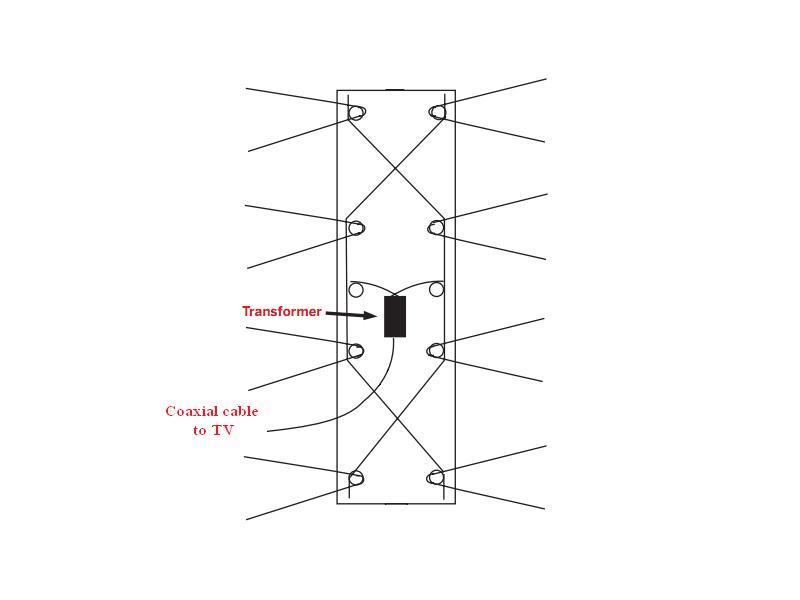
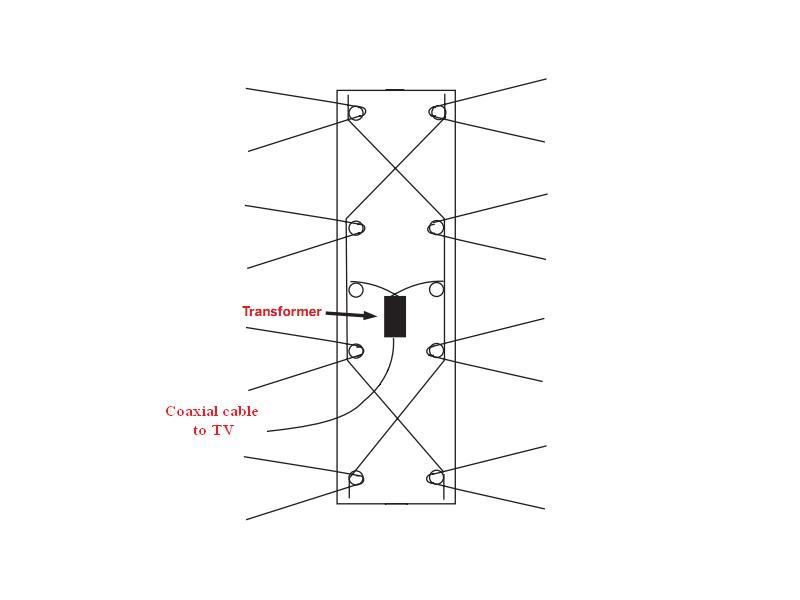
I put this project here because I completed it and wanted to add my comments. I omitted the base which I didn't build, and updated the schematic. Please move or modify it as necessary for content and copyright compliance!


Hi, how are you! glad to read your comment. I want to build it too, but I don’t have matching transformer. could you please tell me which store to buy from. thank you.
my email is huangshiyufu@hotmail.com
That’s a tough one… Try using all the same type of hanger, and maybe try a few different types of hanger to see which works best. Make sure there is good contact everywhere the metal should be connecting, and that the wires are insulated where they should not be connecting. The angles are very precise, and in my model I’m always surprised how little motions can destroy the reception. Let us know if you sort it out, and what you try!
One thing the transformer does is take the coaxial cable and split it into two wires. I don’t know if a transformer does things other than that. To mimic it, try using alligator clips, or soldering wires separately to the inner wire and the ‘shielding’. See http://en.wikipedia.org/wiki/Coaxial_cable to get a good picture of the wires. Attach the shielding to one of the center connections, and the inner wire to the other. Let me know how it goes!
This provides more channels and better reception than any store-bought antenna I have tried. I mounted mine on a wall near the ceiling and facing the transmitters in my area. Rather than plugging it in directly to the t.v., I plugged it into the amplifier box from the RCA flat digital antenna which it replaced and which never worked that well.
// What's Trending
Raspberry Pi Design Contest
Ten Tips for Adhesive Tape
Lost PLA Casting from 3D Prints
Seventeen Sneaky Secret Hides
I Have a (Puzzling) Dream
10 Things to Connect to Your Raspberry Pi
47 Raspberry Pi Projects to Inspire Your Next Build
Teardrop Camper Trailer
// What's Shared
A better way to slice a pumpkin
DIY Nerf Darts
100 Dollar Store Organization Ideas for Craft Rooms and Beyond
In the Maker Shed: Minty Boost USB Charger
Mad’s Mouse House
Lace Princess Crowns
I Have a (Puzzling) Dream
Play the Rings of a Tree Trunk Like a Record
// Most Commented
DIY Hacks & How To’s: Get Emergency Power from a Phone Line
Resin Casting: Going from CAD to Engineering-Grade Plastic Parts
Ten Tips for Screws and Screwdrivers
Ten Tips for Better Measurement
Is it a Hackerspace, Makerspace, TechShop, or FabLab?
Makers on TV: Big Brain Theory
Arduino Announces New Wireless Linux Board
Tool Review: BioLite CampStove