









Make: Projects
Laser Harp
Play strings of light, using laser pointers,rangefinders, photocells, and Arduino.
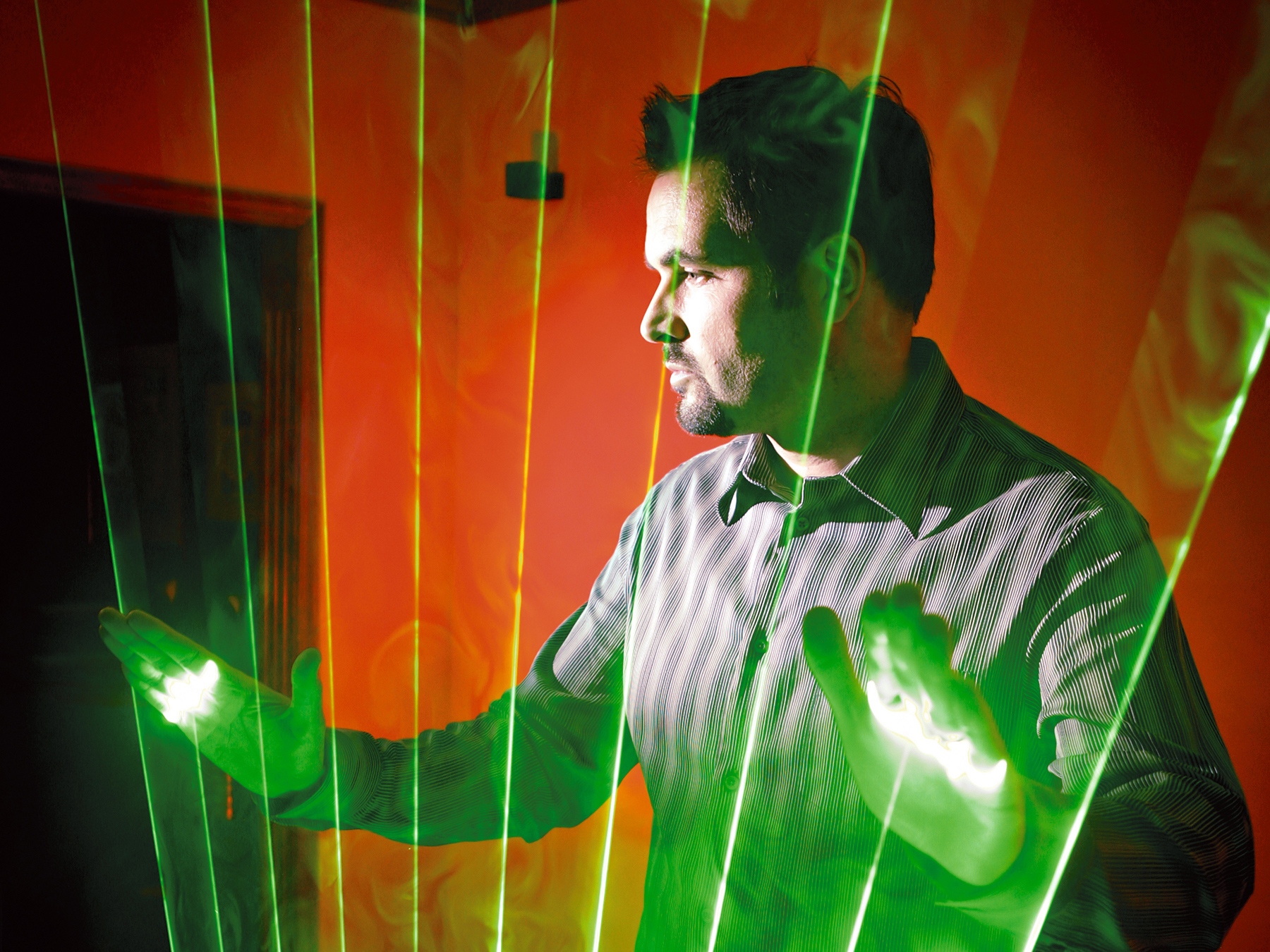
One of my most vivid concert memories is seeing Jean Michel Jarre perform in 1986 at the city of Houston’s 150th birthday celebration. He played music by breaking laser beams with his hands. The beams came out of the stage and went off into space, and for a long time I thought it was a fake — I couldn’t understand how this instrument could work without any sensors above. That started me researching and tinkering, and 22 years later, I figured it all out and built my own.
Now I have several versions of the laser harp. The one I perform with uses a powerful laser and a scanning mirror system, designed for professional lighting effects, that splits one beam into multiple beams that can fan out and move dramatically. This article describes a simpler harp I designed more recently, which uses inexpensive laser pointers and doesn’t need the scanner.
The harp works as a MIDI controller, so it doesn’t make sound itself, but generates a stream of MIDI data to drive an audio synthesizer. Each beam strikes a photocell, and when the player’s hand interrupts it, the sensor prompts an Arduino microcontroller to send a MIDI “Note On” message. Additionally, a range sensor reads the position of the hand, which spawns MIDI controller messages that change the sound’s qualities.
First I’ll show how to make a single-beam laser theremin, which changes pitch with the position of your hand. Then we’ll replicate the circuit and reprogram the Arduino to produce a multi-string harp, with each beam corresponding to a different note. The Arduino has 6 analog inputs, so this harp is limited to 6 beams, but at the end of the article I’ll suggest ways to expand it.
Steps
Step #1: Build the Pieces
Next
- We’ll build the main electronic components first and then put them together. We’ll start with the common power supply, light detector circuit board, and MIDI output jack. Then we’ll add photocells, range sensors, and lasers — 1 of each for the theremin, and 6 of each for the harp.
Conclusion
This project first appeared in MAKE Volume 15, page 64.


one of the student of my college had made this for college’s technical event for aprox. cost of INR 25k
Built this project for school, having a bit of trouble with the code. It works for the midi test file but when i try to do the theramin im getting a message
/////////////////////////////////////////////////////////////////////////////////////////////////////////
// Plays a MIDI note.
// Format of MIDI note on
// 1 – xxx is 001 (Note On), yyyy is the channel number – in our case 0000 – which is channel 0
// 0 – note number 0-127
// 0 – note velocity 0-127 – instead of sending a note off, you can send 0 in this field to silence a note
/////////////////////////////////////////////////////////////////////////////////////////////////////////
void SendMIDI(char cmd, char data1, char data2)
{
Serial.print(cmd, BYTE);
Serial.print(data1, BYTE);
Serial.print(data2, BYTE);
As of Arduino 1.0, the ‘BYTE’ keyword is no longer supported.
Please use Serial.write() instead.
Any ideas?? Im so close to this all working and I need to submit it to the teach by Friday. PLEASE help!!! Thank you!! Can email me @ Gleason.c@gmail.com
where do you get the midi output jack from?
I found scrap parts to make my midi jack. Hopefully getting my harp done this week.
// What's Trending
Raspberry Pi Design Contest
Maker Faire: Day One
A Photo Tour of Maker Faire
Arduino Announces New Wireless Linux Board
Seventeen Sneaky Secret Hides
10 Things to Connect to Your Raspberry Pi
Radio Shack Unveils the New Delta Series Mini PC Board at Maker Faire
New Arduino Robot Available in the Maker Shed at Maker Faire
// What's Shared
A better way to slice a pumpkin
DIY Nerf Darts
In the Maker Shed: Minty Boost USB Charger
100 Dollar Store Organization Ideas for Craft Rooms and Beyond
Mad’s Mouse House
Lace Princess Crowns
I Have a (Puzzling) Dream
Play the Rings of a Tree Trunk Like a Record
// Most Commented
DIY Hacks & How To’s: Get Emergency Power from a Phone Line
Resin Casting: Going from CAD to Engineering-Grade Plastic Parts
Ten Tips for Screws and Screwdrivers
Ten Tips for Better Measurement
Makers on TV: Big Brain Theory
Pitches with Prototypes: Solar Tracker
Grow: A Portable CNC Router System
Tool Review: BioLite CampStove