









Make: Projects
Simple Van de Graaff Generator
Shoot electrical sparks with a soda can, rubber band, and PVC pipe.
When I was younger, I spent hours perusing Bill Beaty’s electrostatics web pages. At the time, I didn’t achieve any real successes trying to build his high-voltage contraptions, and so my interest waned.
Years later, I saw someone online use a soda can as a collector for their Van de Graaff generator, and all my childhood memories of futzing with styrofoam and foil came rushing back. I made my first sparks that afternoon, after a quick stop at our local surplus store.
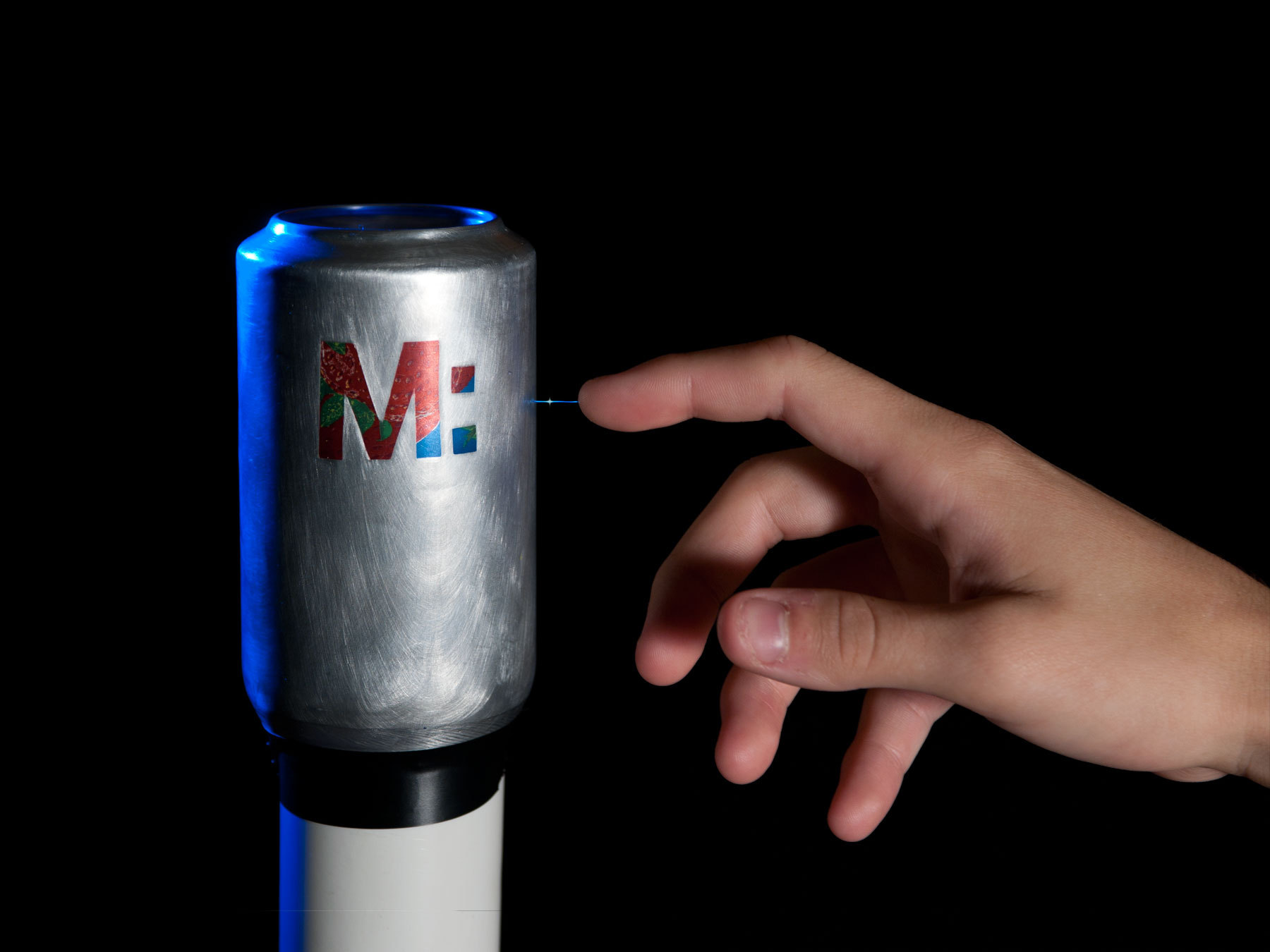
Here’s the simple design I came up with after consulting several tutorials. Using this device, I’ve generated thick, bright sparks 3" long, and faint sparks 6" long. Hold your finger close to it in a darkened room and you will see an eerie blue corona around your fingertip.
How It Works
There are 2 types of Van de Graaff generators. This one uses the triboelectric effect, in which certain materials become charged by contact with other materials — like when you rub a balloon with your hair.
During operation, a motor and roller at the bottom of the generator drive a rubber belt around a glass roller at the top, which creates a negative charge on the belt. A metal brush transfers this charge to a soda can, which is able to store a large amount of charge because it is both hollow and a conductor. The belt meanwhile becomes depleted of free electrons and needs to be replenished, and so a second brush at the bottom pulls in charge from whatever it’s connected to.
Steps
Step #1: Build the base.
Next
- Stand the 3"×1½" PVC coupling on its wide end, and insert the 1½"×1¼" bushing. Cut a length of 1¼" PVC pipe about 2" long and insert it into the bushing. Don’t jam the parts together. Press-fit them just enough that they’re joined, but loose enough to disassemble.
- Connect the tee to the 2" length of pipe
Conclusion
Operation and Experiments
To increase the stored charge, hold the bottom brush. You’ll get the biggest sparks by holding the back of your hand flat alongside the can, and if you point a finger near it in the dark, you may see the air glow blue.
Tape threads or tissue paper strips to the can; they should spread out and repel each other. Tape a bent paper clip or wire to the can, and instead of building up a charge, the end of the wire will create a small wind of ions. Blow bubbles or drop confetti near your generator and watch what happens.
Troubleshooting and Adjustments
Humid environments inhibit the triboelectric effect. Test-rub a balloon or a fleece blanket on your head; if it doesn’t generate static, it’s too humid. You may be able to get your Van de Graaff generator to work after blowing hot air through it with a hair dryer.
If it still isn’t working, remove the can and go back over Step 9 (assembly), checking the brushes and belt. Also try cleaning the rollers or replacing the rubber band. All working surfaces must be clean, dry, and free of oil.
Once the generator works well, cover the rim of the can with electrical tape and attach it to the coupling. Covering the can-opener marks increases the maximum charge.
Eventually, the Van de Graaff generator will attract dust, reducing its effectiveness. Wipe the dust off with a dry cloth to return the generator to peak ability.
This project first appeared in MAKE Volume 28, page 124.


im tryin to build 1 bt the problem is ven i give little tension the rubber band does not rotate plz help…
I am trying to build one but can’t get the electrical tape to stick to the rotor shaft. The rotor shaft is about a third of an inch long, which I noticed is the same as the recommended one from Jameco. If I were to trim down the electrical tape as was suggested, there would be no length to attach the rubber band, never mind to make a crowned pulley. Recommendations?
Hello, I am student and I am trying to do this project. My question is in terms of the measurements what does 1½’ mean what is the equivalence in inch of frac?
1½’ means 1 1/2 inches. If you read through the instructions on the bottom, the fractions show up as they are supposed to if you are still confused about how you are supposed to read them!
Good thing you told everyone that … I was having trouble with the fractions…
can I make the collecter with something not can or ball shaped?
// What's Trending
Raspberry Pi Design Contest
Maker Faire: Day Two
Seventeen Sneaky Secret Hides
10 Things to Connect to Your Raspberry Pi
Maker Faire: Day One
DIY Hacks & How To’s: Swiss Army Key Ring
47 Raspberry Pi Projects to Inspire Your Next Build
// What's Shared
A better way to slice a pumpkin
DIY Nerf Darts
In the Maker Shed: Minty Boost USB Charger
100 Dollar Store Organization Ideas for Craft Rooms and Beyond
Mad’s Mouse House
Lace Princess Crowns
I Have a (Puzzling) Dream
Play the Rings of a Tree Trunk Like a Record
// Most Commented
DIY Hacks & How To’s: Get Emergency Power from a Phone Line
Resin Casting: Going from CAD to Engineering-Grade Plastic Parts
Ten Tips for Screws and Screwdrivers
Ten Tips for Better Measurement
Makers on TV: Big Brain Theory
Arduino Announces New Wireless Linux Board
Build a “Boomcase” and Upcycle that Old Suitcase
Tool Review: BioLite CampStove
Trending Topics
Get our Newsletters
About Maker Media
Subscribe
to MAKE!
Get the print and digital versions when you subscribe