









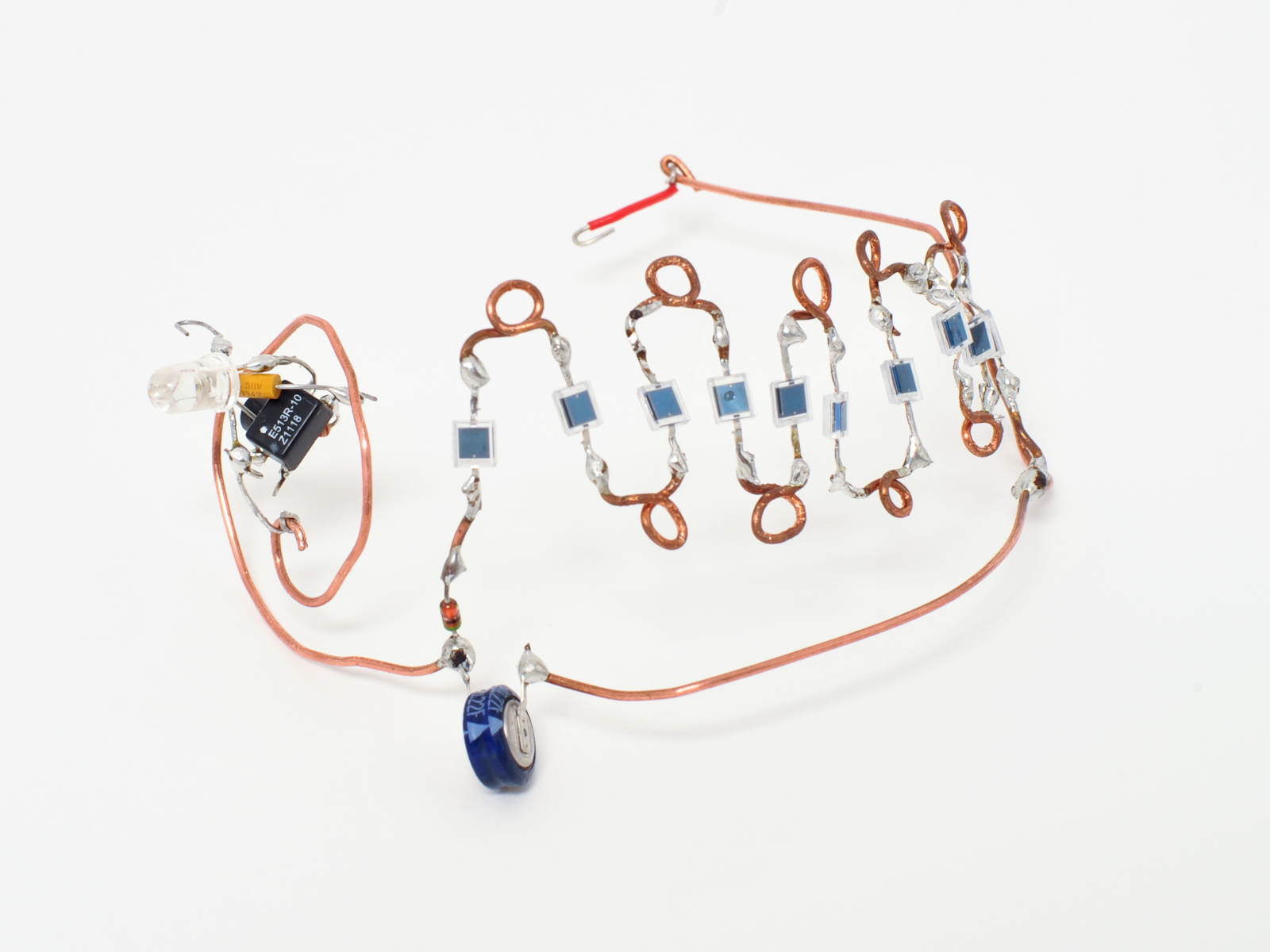
My wife fell in love with Alice Planas and Hatti Lim’s glowing bracelet project from CRAFT Volume 06 ("Solar Jewelry," page 123), so of course we had to make one. I built the circuit and she did the fabric, and it came out nicely, but I felt it could be brighter. So I decided to combine the solar jewelry idea with a Joule Thief circuit, which converts low voltages into short bursts of voltage high enough to light an LED.
This project is the result: the Solar Joule, which combines Solar Jewelry with a Joule Thief. (Note that the joule is a standard measure of energy, and is pronounced like jewel.)
Joule Thief Theory
The Joule Thief circuit is a fairly simple way of converting very low voltages, like from dead batteries, into an oscillating voltage that’s high enough to do something useful. There are many versions online (for example, see bigclive.com/joule.htm). The heart of the circuit is a pair of inductor coils wound together into a transformer or choke. When current runs into one coil of a choke, it’s resisted until it builds up a magnetic field, which then draws current through the other coil, going in the opposite direction. In the Joule Thief, one coil provides the kick of voltage that overcomes the LED’s forward voltage requirement, and the other generates feedback that drives a transistor into oscillations.
Steps
Step #1: How the feedback works.
Next
- Here’s the feedback diagram. When you first connect power to the circuit, the transistor is off. There is no magnetic field in the choke, and there’s not enough power to turn on the LED. Some power leaks through the resistor into the transistor’s base, turning it on a little bit. This lets a small amount of current run backward through inductor coil 1–2 of the choke, creating a small expanding magnetic field. As a result, current is forced through inductor 3–4, which turns the transistor on even more. This positive feedback loop continues until the transistor is completely activated.
- Once the transistor is done opening, the current through 1–2 stops increasing, so the magnetic field stops expanding and the current through 4–3 equalizes. This causes the transistor to close a little bit, which initiates a feedback loop in the opposite direction. Current reverses through 4–3, which closes the transistor and draws current through 1–2. When the transistor shuts off, the inductor’s magnetic field winds down and unloads a blob of charge at pin 2. Once this exceeds the LED’s forward voltage, the LED lights up. The current is quickly exhausted.
- The capacitor between the resistor and the choke provides a little “spring” to the feedback action, speeding it up and buffering some of the voltage changes across inductor 4–3.


