









Make: Projects
Teardrop Camper Trailer
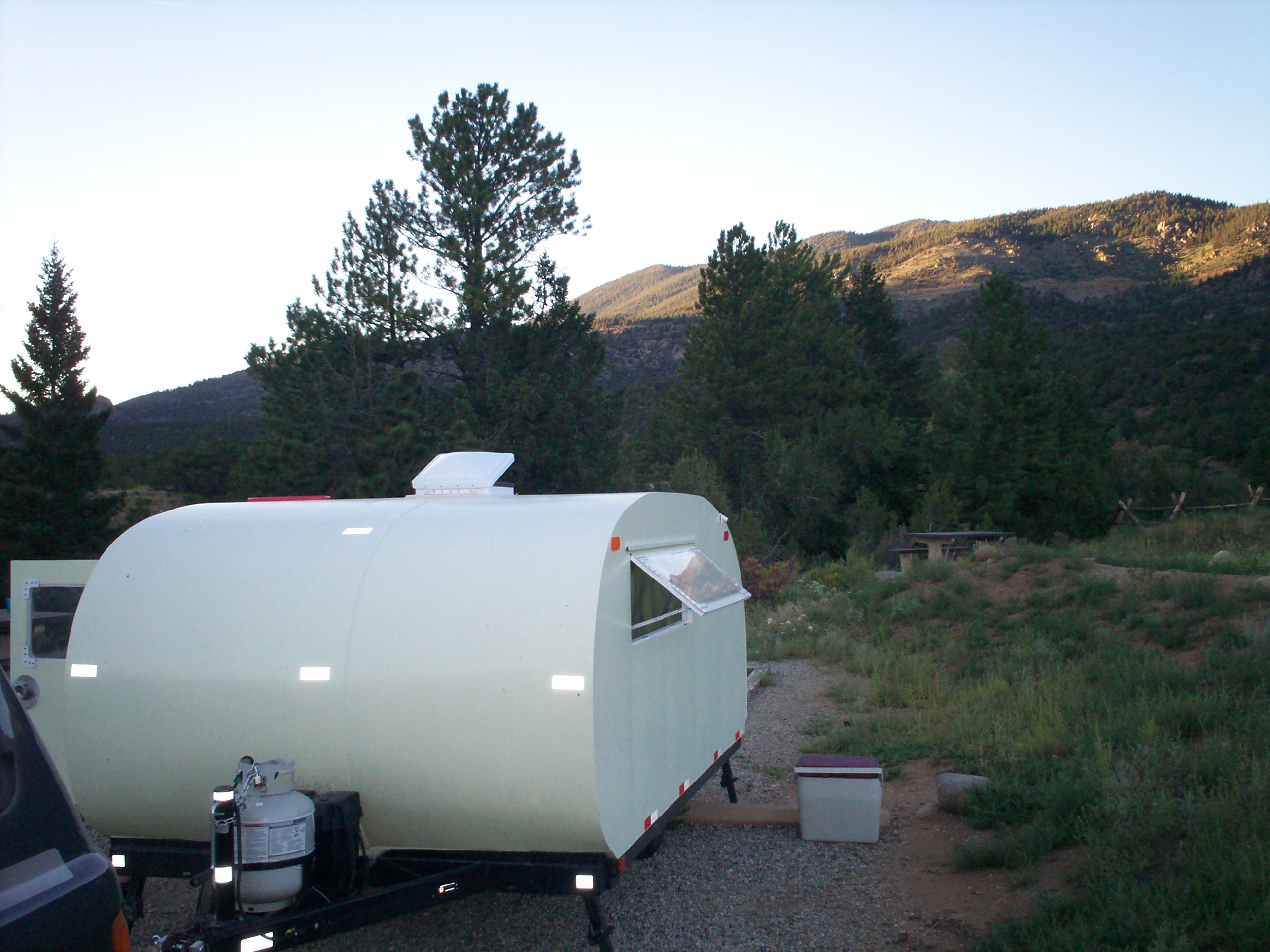
With this project I tried to recreate a 1930s-style teardrop camper trailer.
Well, I am new on this, although I have built a couple of airplanes, worked on flight testing as a structures tech, and specialized on composites. I decided to use the "original composite," plywood (which happens to be the cheapest, too), to build a compact camper. It all started on a trip to lake McConaughy in Nebraska. We were lured by a friend who had a sailboat with the promise of a nice lake with sandy beaches, crystal clear water, and a nice camping site. Everything was true but the wind, the frogs, the huge biting flies, and a massive category-five thunderstorm that soaked us inside the tent. My wife said that she had had it with the tent and unless I found something else to camp in, she was out.
Enter the Internet. I needed something like a popup camper… hmm… search, search… wait, what was that? A teardrop camper… hmm, looks cool, a little small… I can make it a little different, for the three of us… I may be able to pull that with the car I have…
Here begins the story:
First, with my helpful neighbour (he is a veteran of Craigslist) I found a dilapidated popup camper. The thing towed nice, but (caveat emptor) when I removed the siding to inspect it, it just fell apart like a deck of cards. That made it easy; tear the whole thing apart and sell the metal to fund some of the new materials.
Steps
Step #1:
Next
- First, I found an old popup trailer very cheap....
- The old popup camper was dismantled and some parts were recycled. I got some money from the old aluminum siding and stainless steel lifting mechanism.
- The frame was power-sanded, first with a rotary wire brush and then with 80-grit sandpaper. Then it was painted with Rust-Oleum rust preventative, and finally covered with Rust-Oleum black paint.
Conclusion
This project can take some time depending on your skills, work space, weather, and time availability. Make sure you find a design that fits your needs, and make sure you follow safety rules around power tools. Fingers don't grow back.


Very useful and amazing project………
Can you pls let us know what you used for external? Just paint or plastic wrap or something? Your trailer was in nature wood color and then suddenly changed to white. Can’t tell what you used and how to make it water/rain proof.
Thanks a lot for sharing.
I coated the plywood liberally with several coats of diluted exterior polyurethane varnish, then used Killz primer, and lastly I used Sherwin Williams marine paint, really tough finish, although I had to sand and repaint it after a couple of years outside, I guess it may last longer if it is stored in a garage, or under an awning to protect it from the UV light.
Thanx, best make project to date, I have contmplated doing this and now if I do, I have a lot of ideas.
If you do decide to build one, Mark, please let us know. We love to report on your progress/results.
Won’t be any time soon but if I do, I will!
A trailer’s wiring plug that goes into the tow rig is often a problem. When not in use it is often hung down to not catch rain but the contacts often corrode in moist air and the plug is often dropped into puddles or mud. A matching dummy plug receptacle (NOT wired or hooked-up) similar to that on the tow rig can be mounted on the trailer out of the elements or shielded. The plug is then either in the tow rig’s socket OR in the trailer’s dummy socket, stored when not in use in it’s place out of the elements. Also, removing the plug from the storage socket is a wiggling motion which cleans the brass contacts giving better electrical contact when plugged into the tow rig.
It is also helpful to spray any electrical contacts or sockets exposed to weather with a little WD-40.
I use battery contact grease, they sell it in little packets at any auto parts store. keeps corrosion at bay and prevents water from damaging the connectors.
Really enjoyed reading this. A question about your walls, is the round part just cut to shape plywood or did you do some kind of bending?
The curved part ( basically the front, roof and hatch) is 1/4 inch Luan plywood, it required some effort to bend, I started it gluing and fastening with brass screws at the bottom then glued and nailed with brass nails to each of the “rungs” using Titebond wood glue, it has been three years of heavy use and it is holding really well.
Werner
Lovely! Is there a dedicated battery in the camper? You could put a deep cycle marine battery between the wheels for off the grid use.
PS – A mini-bungee on your kitchen “shelf” will provide tension and keep small items from shifting around or falling out. Hang a magnet bar to act as a spoon rack and knife holder (while parked only
. Also, check the oven specs to make sure you don’t need to put backerboard or high temp insulation. Most RV/camper ones will be ok with the insulation provided.
C- for reading comprehension – just saw the battery on the hitch.
The great thing about Make-ing is that you can see what others have done, and think about tweaking it!
How much did it cost you for all of the materials needed to complete the project? Your wife did a wonderful job decorating and coming up with the kitchen sink. Very creative project,
My total cost was around 2000 dollars, but I recycled a lot of wood from construction sites, just ask, they have a lot of wood in their refuse bins they are more than glad to give away as they pay per pound to haul it away…If you buy what you need as required it does not hurts as much, besides, if you change something, you are not stuck with “extras” that add up to the final expense.
How much was the final weight for towing?
The final weight was 1640 lb, but I overbuilt it to withstand rugged ” washboard” roads, you could go down to half the weight if you forgo the insulation and “double paneling” I did.
I hate to burst your bubble. What you built is not an inverter. You(?) built a basic 12VDC power supply. An inverter would take your internal 12V(from your truck or other installed battery) and convert it to 120VAC(household type voltage) so you could use your standard home appliances. These are not that easy to build .
On fusing: you really tried, but to blow that 7amp fuse, you could do some serious welding as well as melt the power supply down till your trailer burned. Pure speculation says that you could probably get by with a .3amp fuse! (one third of one amp.)
What I built (in the kitchen section) is properly called a rectified power supply, that transform 110 volts AC into 12VDC, and 28VDC, at 4 amperes, it also has a pass through for when I have it connected to an external power supply, the little outlet on the right side, that one has a 10 amp breaker, the power inverter is inside the camper, it is a 400 watt inverter to recharge lap tops, or cell phones, as well as to be able to use a small DVD player at night, The “fuses” are actually Aircraft Circuit breakers, rated to 250 Volts, 400 cycles, they will not melt, guaranteed, the circuits are independent, and wired with 12AWG, shielded cable. every circuit is calculated to “open” at their rated capacity, the 3 Amp is for a couple of LED lights, and the 12 volt is for the battery operated inverter, and a couple of low power 12VDC outlets, no need to ” burst my bubble”
PS: Rick Setzer, why your comment sounds so hostile?…..if you don’t have anything good to say, please turn your computer off.
Who is hostile? I really like your project. You were the one that stated you built an inverter. Indeed you state now that you built a 12VDC power supply, which is one thing I said. My comments about the ‘inverter’ you built and the fusing associated with it were correct if you had built an inverter. Now with the added information, it sounds like you may have gotten almost everything right. One little area of concern now: those circuit breakers. Breakers designed for 400hertz do not work quite the same on 60hertz. At 60hertz you have more heating effects for the same voltage. I have many years in electrical/electronic repair, including avionics. I was concerned on reading your narrative on your ‘build’ that others may create a hazard if they did not fully understand the electrical part of it. Telling someone to turn off their computer is very childish.
If you read your comment about ” bursting bubbles” and ” you really tried”….does not sound very friendly, just a heads up, it is very easy to be a “tough guy” on internet, This forum is to help people create and innovate, it is not a place to put people down with an attitude of superiority.
I think it is hard a lot of times to relate “Emotion” into text which might come off the wrong way. Dont think either party was looking to start a debate in a negative way at all but one offering knowledge to help others.
Do you have PDF off this project ready to download? I love your project and I want to start looking for an old pop up trailer to start . The Mrs. And I see this as a joint build venture. We love doing things like this together!
In regards to your 400Hz breakers, the only problem would be make sure you do not go over the prorated current rating for both DC and 60Hz AC. It looks like the total load on each branch would be about 1.5 A. The rectified PSU seems to build well and I think would like to build this( I am an electronics Tech).
Thanks, Werner, for this wonderful project.
Hi Dave, I have a pdf of the article, but not a CAD file to work with, I just worked it out by “feel”, but I have a post on another website with step by step on how I did it, (bigger pictures):
http://www.tnttt.com/viewtopic.php?t=40209
Great build. I am truly impressed with your time and dedication to not only your own personal build, but your instructional pictures and editorial. Thanks for a great education and read.
// What's Trending
Raspberry Pi Design Contest
Seventeen Sneaky Secret Hides
Lost PLA Casting from 3D Prints
10 Things to Connect to Your Raspberry Pi
Teardrop Camper Trailer
5 Million LEGO Brick Star Wars X-Wing Starfighter
Ten Tips for Adhesive Tape
DIY 3D Laser Scanner Using Arduino
// What's Shared
A better way to slice a pumpkin
DIY Nerf Darts
100 Dollar Store Organization Ideas for Craft Rooms and Beyond
In the Maker Shed: Minty Boost USB Charger
Mad’s Mouse House
Lace Princess Crowns
I Have a (Puzzling) Dream
Play the Rings of a Tree Trunk Like a Record
// Most Commented
DIY Hacks & How To’s: Get Emergency Power from a Phone Line
Resin Casting: Going from CAD to Engineering-Grade Plastic Parts
Ten Tips for Screws and Screwdrivers
Ten Tips for Better Measurement
Is it a Hackerspace, Makerspace, TechShop, or FabLab?
Arduino Announces New Wireless Linux Board
Ten Tips for Adhesive Tape
Makers on TV: Big Brain Theory
Trending Topics
Get our Newsletters
About Maker Media
Subscribe
to MAKE!
Get the print and digital versions when you subscribe