Make: Projects
Workhorses
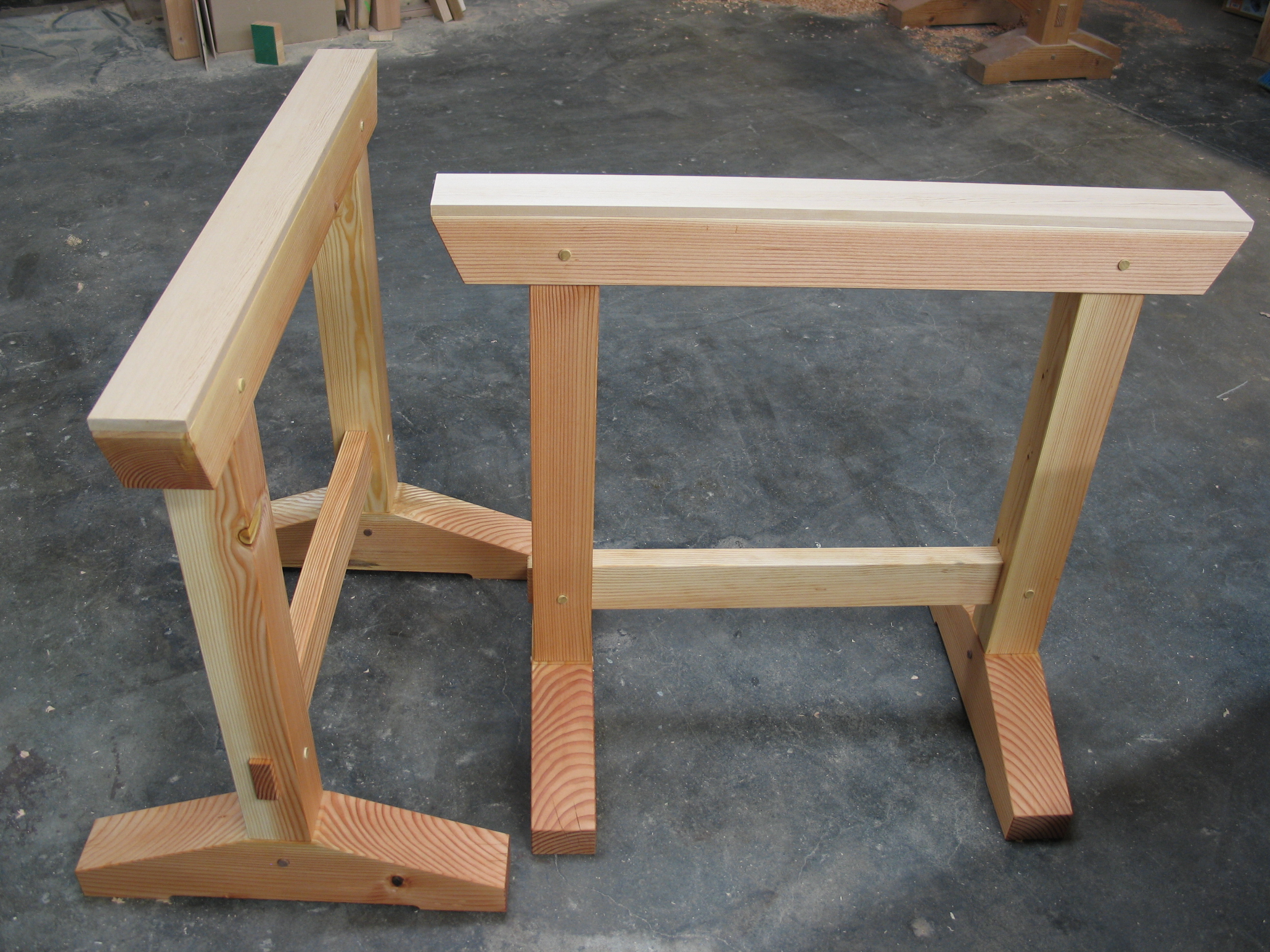
Use a simple mortise-and-tenon joint to make these fine-looking shop horses that’ll last a lifetime.
Based on the trestles of a Japanese woodworking bench, these sawhorses are a good beginning joinery project.
They’re constructed using the mortise and tenon, the fundamental joint in woodworking. The tenon (end projection) of one piece fits into the mortise (hole) in another piece.
This project uses the drawbore style of mortise and tenon, which is secured by a wooden pin that draws it tight and makes it look great.
Steps
Step #1: Mortise and Tenon Joint
Next
- What makes a drawbore different from a regular pegged tenon is the offset pin holes. Instead of the pin passing straight through the joint to hold it together, the hole in the tenon is bored slightly closer to the shoulder. This offset causes the tenon to be drawn deeper into the mortise when the wooden pin is driven through.
- Watching a joint that you made pull itself together like that is a very cool thing. And when you feel how strong it is with no glue or metal fasteners, it opens doors in your head. You realize that joinery isn't just the realm of mountain-dwelling woodworking mystics, but an accessible approach to working with wood.
- The joint may look intimidating, but if you take your time and use sharp tools, you’ll be surprised at how easy it is. And while the drawbore style is a little more complicated, when cut carefully it’s fairly forgiving of loose fits, a bonus for the beginner.
- If you’re comfortable around woodworking tools, these horses should present a light challenge, then last a lifetime. Because of their myriad uses in the workshop, to call them sawhorses would sell them short. I prefer workhorses.
Conclusion
This project first appeared in MAKE's Ultimate Workshop and Tool Guide, on page 38.


Thanks Ben! The 12″ was indeed the result of incorrect porting and should be 1-3/8″. It’s fixed now.
I upload pictures of my horses to [http://www.flickr.com/photos/popdan/sets/72157628365776867/|flikr...]
Notes about finishing this project using hand tools.
These saucy saw horses were intentionally sought-after by myself because I just moved into a home and I didn’t have any type of working surface to create any projects at all. Perhaps I still had the ability to create origami in the kitchen, but origami is only slightly less useless than fine art, so what would be the point?
My garage is small and I needed an operational platform to launch all my home repair projects. Even if I could fit large wood-shop working items in it I certainly couldn’t afford them. Besides traditional woodworking tools being compact, and less expensive than larger power tools; there is a bit of grit and determination behind each piece of steel clad machinery that smells a little bit like manhood.
Since I realized that it is possible for others to attempt to create these saw horses using hand tools, I decided to do everyone a favor and list a few notes about the process below that even Cliffs would be proud of.
- Forget about the 1-2 day initial estimated completion date. I didn’t even plane all the wood in 2 days.
- Most of the time spent on this project is meticulous prep time to make sure that your cuts are accurate and are producing the greatest yield per board. so don’t skimp on this process because it is the most important part.
- Be a nice neighbor and borrow a rickety work table from them, but be prepared to bake them a pie afterwards. there are plenty of blogs to teach you how to bake such sugary items.
- I have included a link to some photos I used to create this project that have a far better description about them that can write in this comment section.
http://bit.ly/10TZeBn It has a few images of tricks i used to make life a lot easier.
- always test the assembly before you commit to glue.
- Don’t forget! Work makes the mind happy, so take it easy on rushing the process because there are plenty of opportunities to fudge it up. Fortunately this is fairly forgiving project so be sure to enjoy yourself while working.
Must have items to compete this project
- A Jack plane : I dont know why boards at home depot or menards have rounded corners on them, but they wont do you any favors, so you must learn to love planing.
- A saw with at most 5 teeth per inch!!! if your saw has more teeth per inch than 5 you are fk’d!
- Measuring tape
- wood working knife: your leatherman will do the trick.
- Chisels.
- Mallet with a plastic end: this is for whacking the snot out of the chisels.
- Hand drill with appropriate drill pits.
- two sharpening stones. 1 fine 1 course & some honing oil keep those blades nice and sharp
- a hand towel: for sweat and tears.
// What's Trending
Raspberry Pi Design Contest
Maker Faire: Day Two
Maker Faire: Day One
Seventeen Sneaky Secret Hides
10 Things to Connect to Your Raspberry Pi
A Photo Tour of Maker Faire
Adam Savage Exhorts the Makers to “Work Hard and Work Smart”
Arduino Announces New Wireless Linux Board
// What's Shared
A better way to slice a pumpkin
DIY Nerf Darts
In the Maker Shed: Minty Boost USB Charger
100 Dollar Store Organization Ideas for Craft Rooms and Beyond
Mad’s Mouse House
Lace Princess Crowns
I Have a (Puzzling) Dream
Play the Rings of a Tree Trunk Like a Record
// Most Commented
DIY Hacks & How To’s: Get Emergency Power from a Phone Line
Resin Casting: Going from CAD to Engineering-Grade Plastic Parts
Ten Tips for Screws and Screwdrivers
Ten Tips for Better Measurement
Makers on TV: Big Brain Theory
Arduino Announces New Wireless Linux Board
Pitches with Prototypes: Solar Tracker
Grow: A Portable CNC Router System